The Gates of Brazenthrone

“How big is Brazenthrone going to get,” you ask? This is just the door.

The next part will be the entrance tunnel and the fortified inner gates (marked as 3 here). They’re the fallback defensive position in case the main gates are taken and they’re basically a meat grinder. You’ll see why.

Before that, we’ve got an Alchemists’ Guildhall and Manufactory, the map chosen by the Cartographic Congress last month.

Finally, here’s the non-annotated version and the black and white. DM notes for this map are available to patrons. Also, starting with this map, I’ll be making VTT versions of all maps, sized for Roll20, for patrons.

Brazenthrone Surface Trading Outpost

Here’s the first part of Brazenthrone: the outpost for trading with surface-dwelling peoples just outside the gates. On the city layout map, it’s marked as 1.

The next map to go up will be a ship. After that, the next Brazenthrone map will be the city gates, at 2. Initially, I had planned for these to be fairly simple and not the city’s main line of defense, but I had a change of heart. Brazenthrone is getting some big, impressive, heavily-fortified gates.

Here’s a non-annotated version of this map and here’s the black and white version. Also, DM notes and a Patrons’ Edition of this map with all the rooms numbered and labeled is available on the patreon.

The Dwarven City of Brazenthrone – The Layout

Here’s the black and white version and the non-annotated version.

This is the basic layout of the map I will be drawing over the next year.  Keep in mind that this is at a 70 foot scale, which means that each tile here will become 196 tiles when drawn at a 5 foot scale.  To illustrate how big this will be, the Great Hall, marked as (4) here, is about the size of the ground level of Finbarr’s Marsh (including the surrounding water).

A few things to mention:

  • All of these will have multiple levels.
  • The mines are just a sketch. They will look completely different in the 5 foot scale maps.
  • I will be drawing the residential districts (the unmarked chambers on the map).
  • All of the chambers here will be assembled as one big map when they’re all finished.  And that one map will be so huge it’ll be impractical to use, but it’ll probably be really cool.
  • Finally, any and all of this is subject to change.  A measurement error here and a new idea there will almost certainly lead to changes and/or additions at some point.  But this is the general idea.

I will be alternating between drawing maps for this and drawing other maps.  My next map will be an airship.  After that, Brazenthrone’s Surface Outpost. Then something else.  Then back to Brazenthrone.  And so on.

Alright, let’s do this.

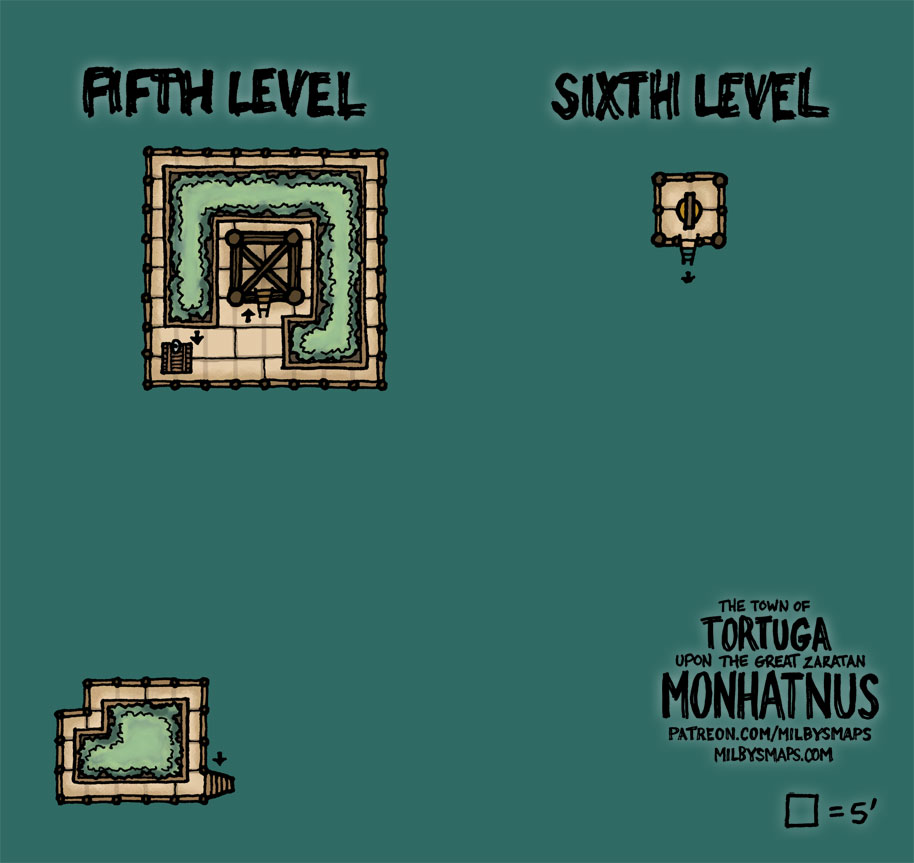
The Town of Tortuga Upon the Great Zaratan Monhatnus – Main Deck


First off:  “What is a zaratan?”

A zaratan is a giant turtle that sleeps for years at a time.  They often come to look like islands, with plants and even trees growing from their backs.  Sometimes, people– knowingly or unknowingly– inhabit those “islands.”  The main problem with living on a zaratan is this: when they get hungry, they wake up and look for food.  And when they look for food, they dive.  Which is catastrophic for anyone living on the creature’s back.  So, in order to prevent this, the zaratan must be fed.  Even sleeping, it will eat anything coming into its mouth.  The town of Tortuga is well-prepared to handle this, having a small fleet of fishing boats and a large crane to deliver their offerings.

The idea for this map came from a patron, who suggested a city on a zaratan.  That’s been done before, of course, but it’s typically a small village with a few huts.  I thought it’d be interesting to make the most overpopulated zaratan ever.

My idea was that the town of Tortuga grew so much that they had to keep building higher and higher, which necessitated constructing the wooden deck on their host’s back.  After all, it’s hard to build a solid foundation on a curved surface, especially when you can’t dig or drill down into it without pissing off a creature that can bite the head off a storm giant.

Here’s a (mostly) gridless version, a black and white version, a version without annotations and a gridless version without annotations.

Since this map is so complicated, I’m releasing this partially annotated edition to all, but there is a fully annotated Patrons’ Edition with around 45 rooms marked available on the patreon.

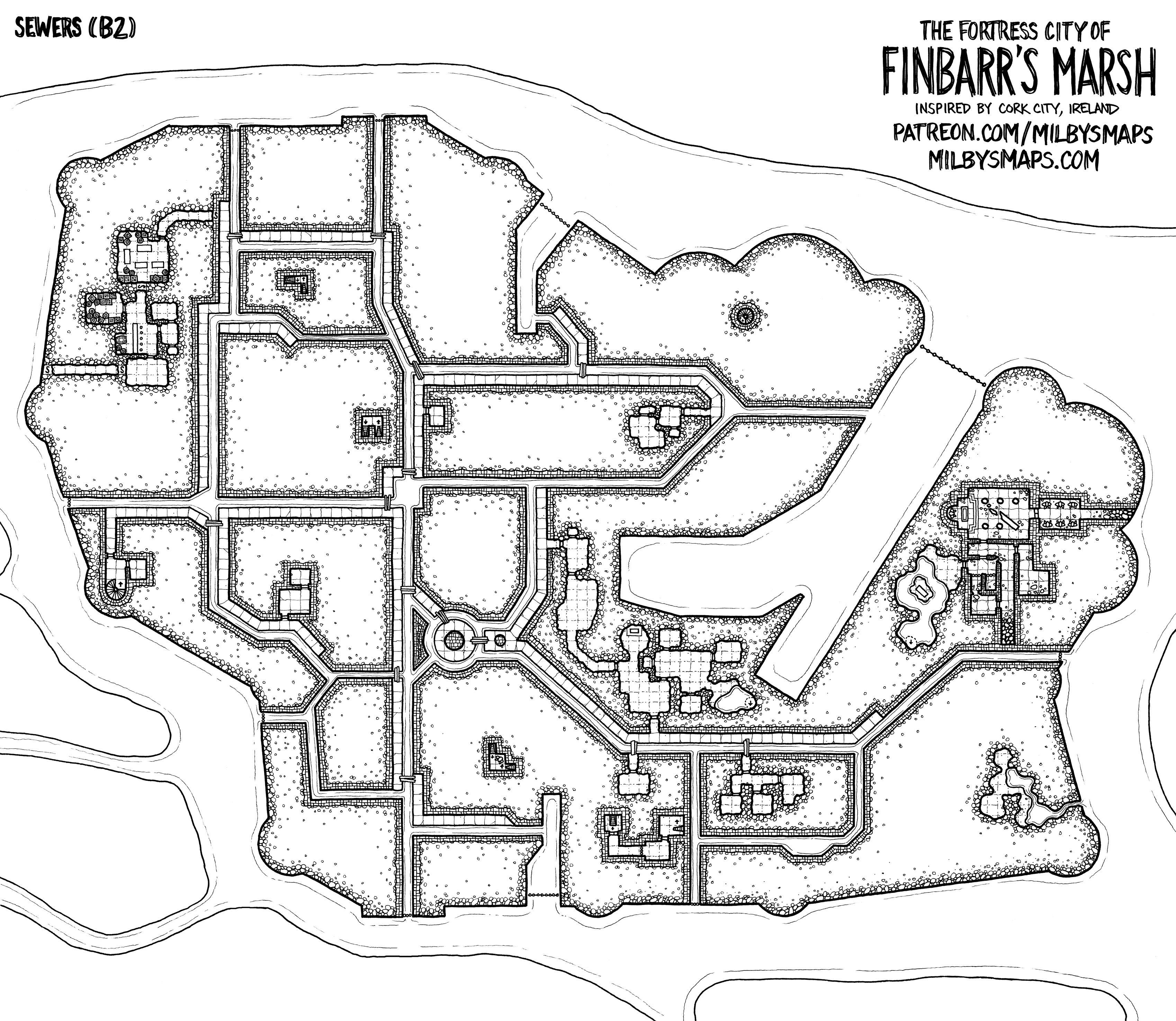
Finbarr’s Marsh – The Sewers


This is the second to last map of Finbarr’s Marsh.  The crypts will be up in a few days.

So let’s talk about the sewers.  First, I need to mention elevation.  The underground level is above this, which means it’s fully above the water level.  Why?  The island has steep sides and the ground level is about 15 feet above the water.  With that out of the way, let’s talk about the locations.

The kuo-toan temple on the left predates the city and was in ruins by the time the first settlers showed up.  The passages into it were eventually blocked off with stone because, well, no one wants an open passage leading right under their castle.

The Drainers are human.  They’re poor and live in the sewers, subsisting on mushrooms and selling their excess fertilizer to farmers in the area.  They smell.  But everything down here smells, so it’s fine.  The authorities know about them and have told them they can stay.  But no more digging.

The Theives’ Guild’s bread and butter, unusually, isn’t theiving, but dealing in smuggled goods.  They have an arrangement with some fishermen to bring goods in from cargo ships, a few crates at a time, evading the customs tariffs and any laws concerning contraband.  They buy the goods from the fishermen, then sell them around the city at a tidy profit.  They’re secretly working with one of the wealthy trading houses as well (the De Barras).  They do also steal stuff.  Sometimes.

The sea trolls (scrags) aren’t a huge priority for the city guard, although they can be troublesome.  And the entrance to their lair is small and completely underwater, which would make dealing with them an enormous pain.

The Witch of the Pipes is whoever you want her to be.

Here’s a version without annotations and a black and white line art version.
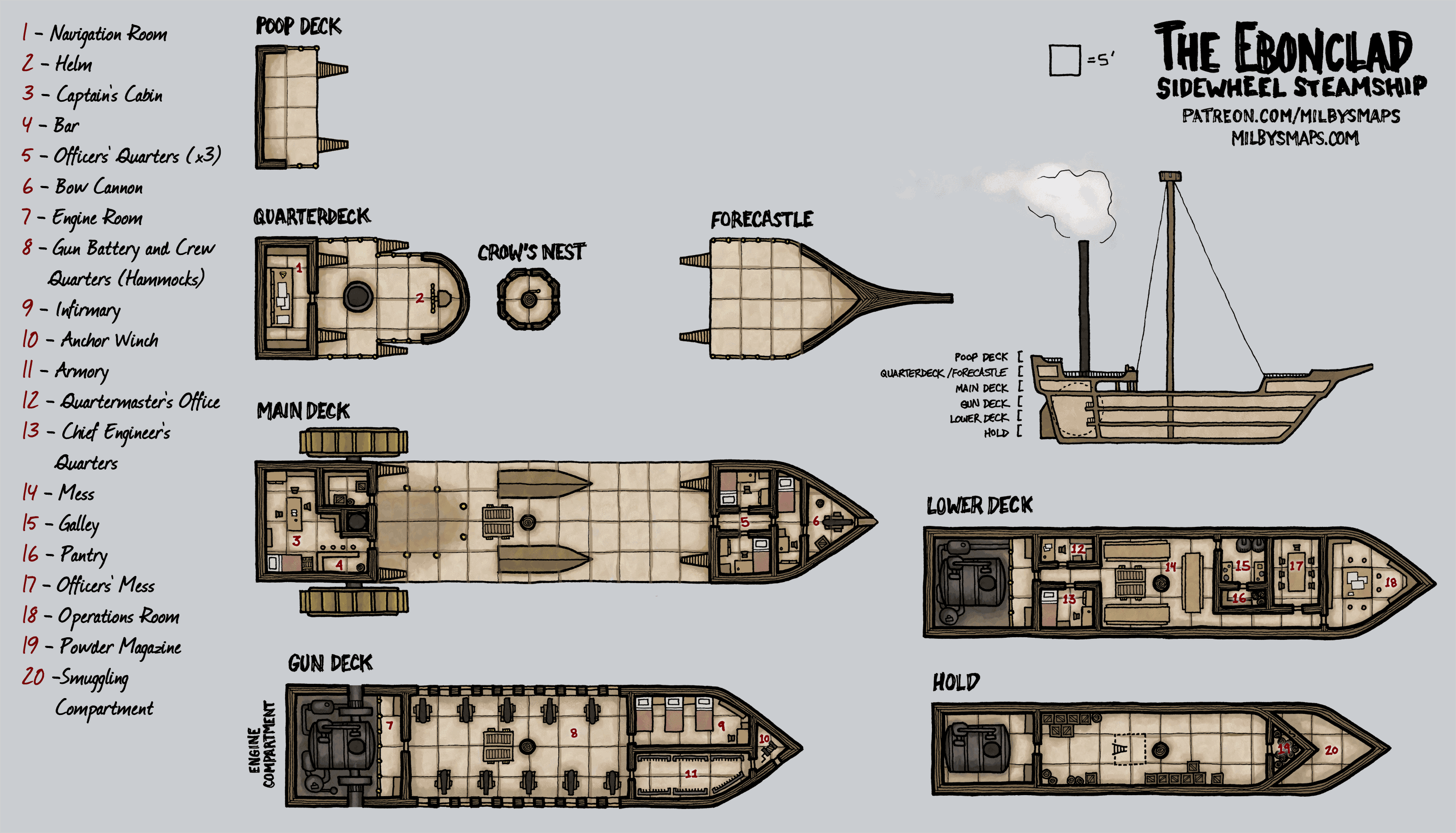
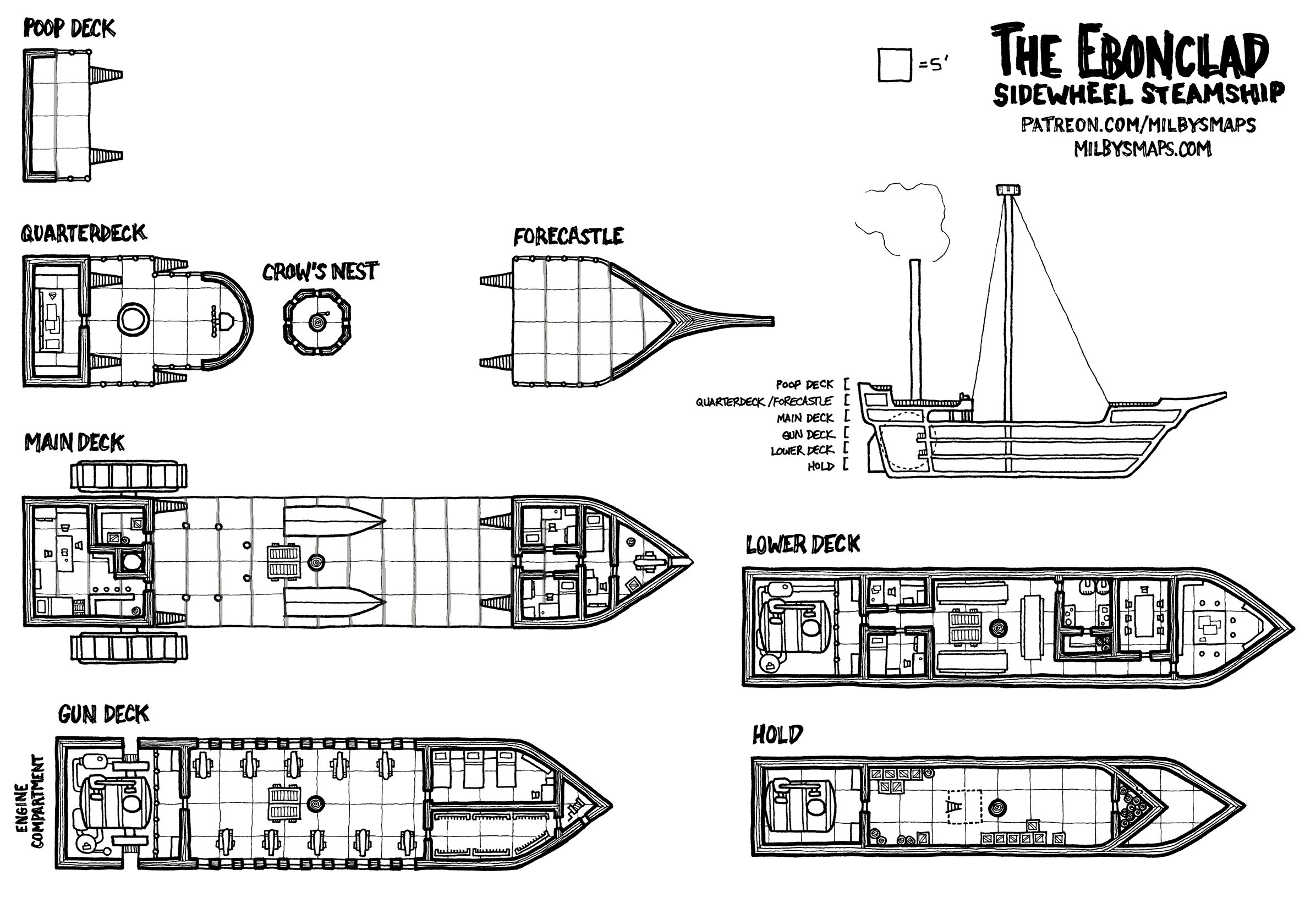
The Ebonclad Steamship


This is the map chosen by the Cartographic Congress last month.

There are a few things to note here.  First, you may notice that there’s no coal pile.  This ship doesn’t run on coal.  The engine is powered by a magically heated chunk of metal which is lowered into the boiler to drive the paddlewheels.  Second, the sails are meant as an auxiliary power source, in the event that the engines suffer some sort of catastrophic failure (either magical or cannonball-based in nature).  And third, the ship would have around 60 crew, plus five officers (including the captain).

Here’s a version without annotations and here’s one in black and white.

Next, we’ll finish off the upper floors of Finbarr’s Marsh and then head underground!

The Fortress City of Finbarr’s Marsh – Ground Level

As long as that took to draw, I can’t believe it didn’t take longer.  And Finbarr’s Marsh isn’t even half finished.  Still to go, we have: upper levels, which most buildings will have, as well as basements, sewers, three crypts, the walls, towers and gatehouses.

I don’t like plugging my Patreon, but I figure this is a good time to say that, if you like what I’m doing and you want to help keep a pen in my hand for as many hours a week as possible, please consider supporting me.

There is a Patrons’ Edition version of this map with over 150 buildings and rooms marked.

Also, here’s a version of the map without annotations.