Elmkirk Children’s Workhouse

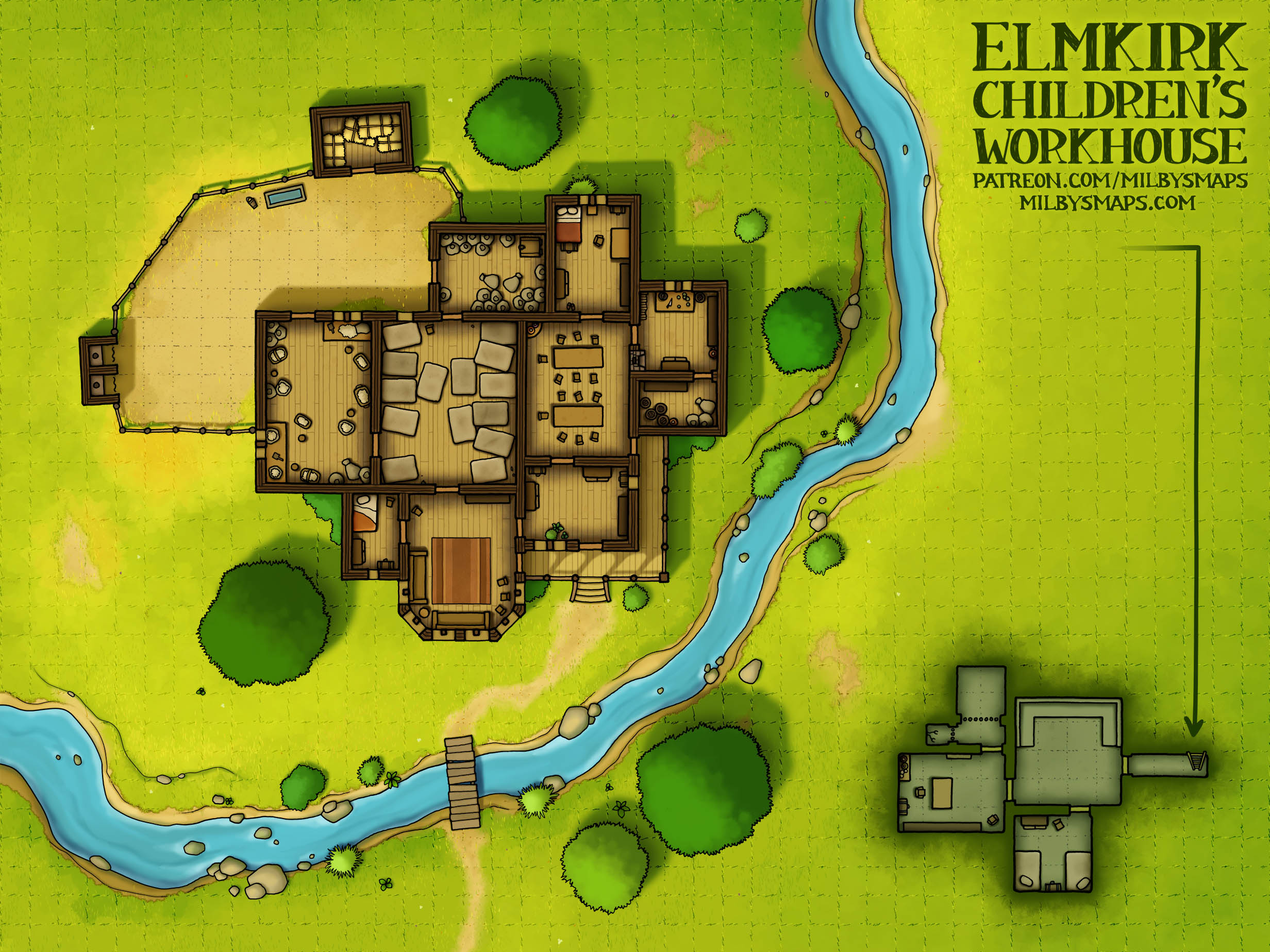
A workhouse is kind of like an orphanage, except much more depressing (as if a building full of children whose parents are dead wasn’t depressing enough). Unlike a regular orphanage, a workhouse could be self-funded using the glorious power of child labor. At Elmkirk Children’s Workhouse, the orphans are put to work carding wool, a low-skill, labor-intensive task.

Try to imagine being in this situation. You’re six years old. Mommy is gone. Daddy is gone. And now, in order to get food and shelter, you have to do the world’s most tedious, unskilled labor for twelve hours a day. You’re six. This is a thing that happened. The past was just merciless.

Anyway, to spice things up a bit, Elmkirk Children’s Workhouse also has a secret cellar that’s used as a meeting place for the local thieves’ guild (or some other sketchy organization). I’m also making a version with a cult temple in the cellar for patrons, which should be done tomorrow.  After that, we’re back to the Vatican!
Belgarten Palace

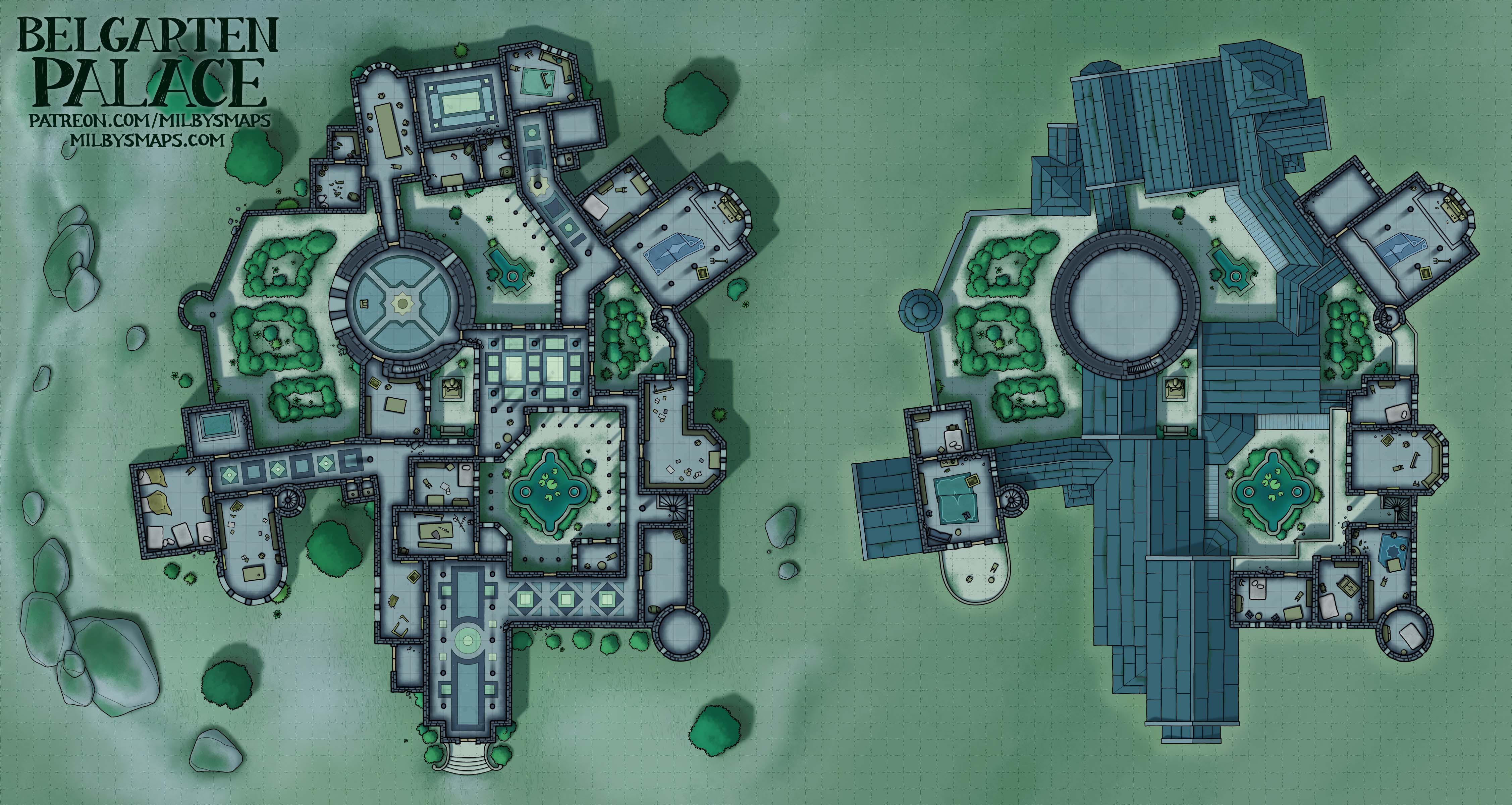
I want to point out the secret door in the large, round room here. When I include a secret door in a map, I don’t actually draw the door (or an “S” where the door would be), because that makes it obvious to your players. And you can’t really hide it in a VTT. So I just draw a wall and leave it to you to decide which side the door is on. I thought I should mention that to avoid any confusion.

I intentionally made this place as convoluted and oddly-designed as possible, which makes it good as a sort of dungeon, I think. Maybe the party is looking for something or maybe they’re clearing out the monsters living here. Or maybe the place was sacked recently and they’re looking for survivors. In any case, there are a lot of potential paths through this place and a lot of different ways in (most of which involve climbing). I think it’d be a fun place to explore and there are some good spots for a battle– especially that courtyard with the big fountain and the walkway overhead.

Next, I’ll be drawing an orphanage with a secret hideout below it. Or possibly behind it. I’m not sure of the layout just yet, but the basic idea is that it’s an orphanage that serves as a cover for some really sketchy people. Maybe it’s a thieves’ guild, maybe it’s a cult of the god of disembowelment. I’ll leave it to you if and how the orphans might be involved. There’s a lot of potential for some highly traumatizing adventures. God, I’ve got some great ideas for this already.

All right, that’s it. I’m gonna get to work sketching out that orphanage. Let me know what you think of the map!


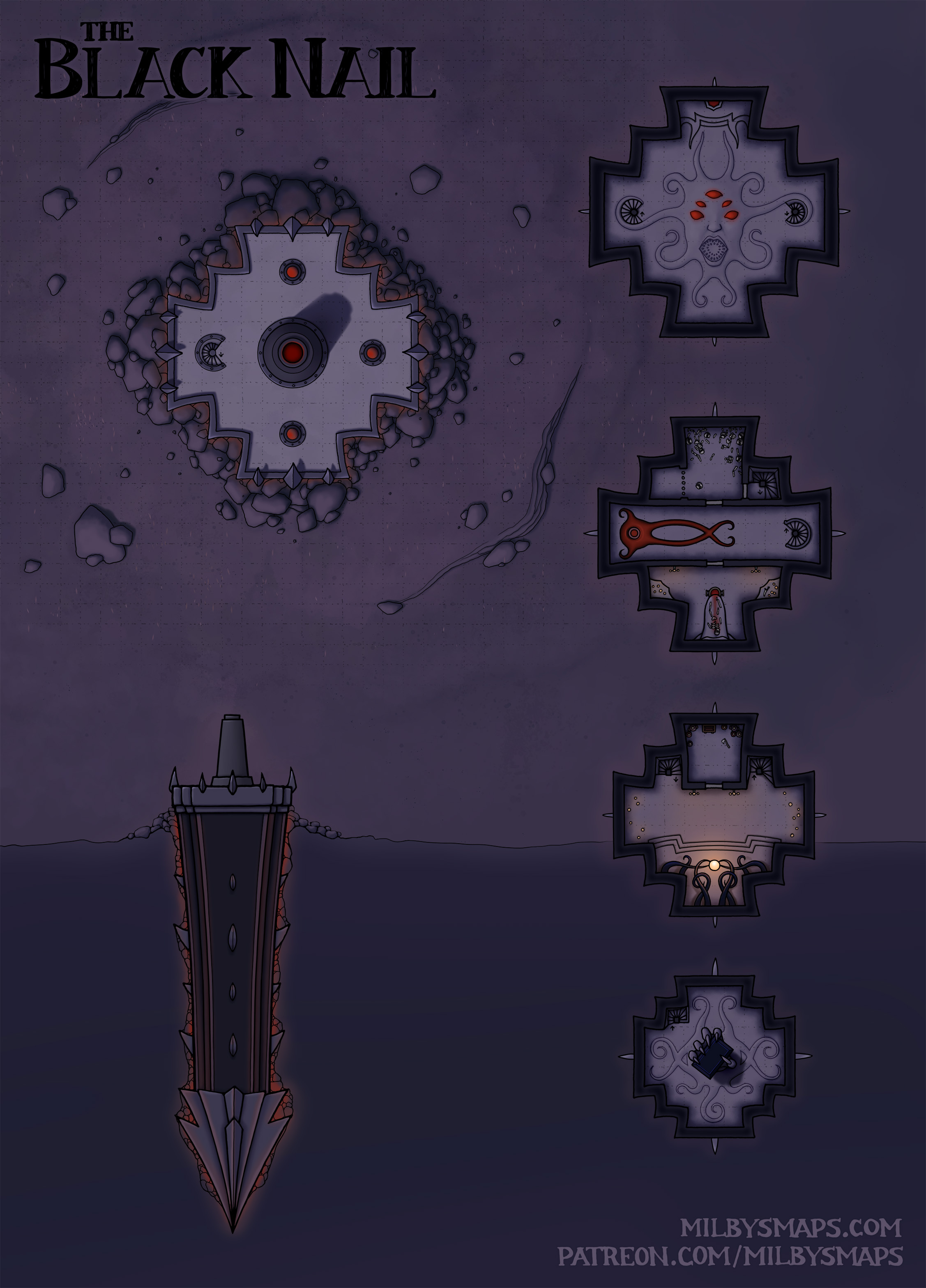
The Black Nail

The Black Nail is a demonic tower that’s been driven into the ground. There’s a bunch of bizarre stuff on each floor, all of which leads down to a giant hand holding a large, stone chest at the bottom. The chest probably contains a demon, artifact, magic item or something pertinent to your campaign. Let me suggest you go one of two ways with this:

  1. There’s a demon/monster/enemy in the chest, or
  2. The hand holding the chest is the monster and it attacks once the players open it.

Or you could do both. I put some suggestions on what to do with the other rooms in the DM notes, so patrons may want to check those out.

Next, I’m going to make a variant of this map for patrons. It’s nothing too elaborate, so I should have it done in a couple days, but I think it might be useful to some of you. Anyway, I’m gonna get to work on that. Let me know what you think!

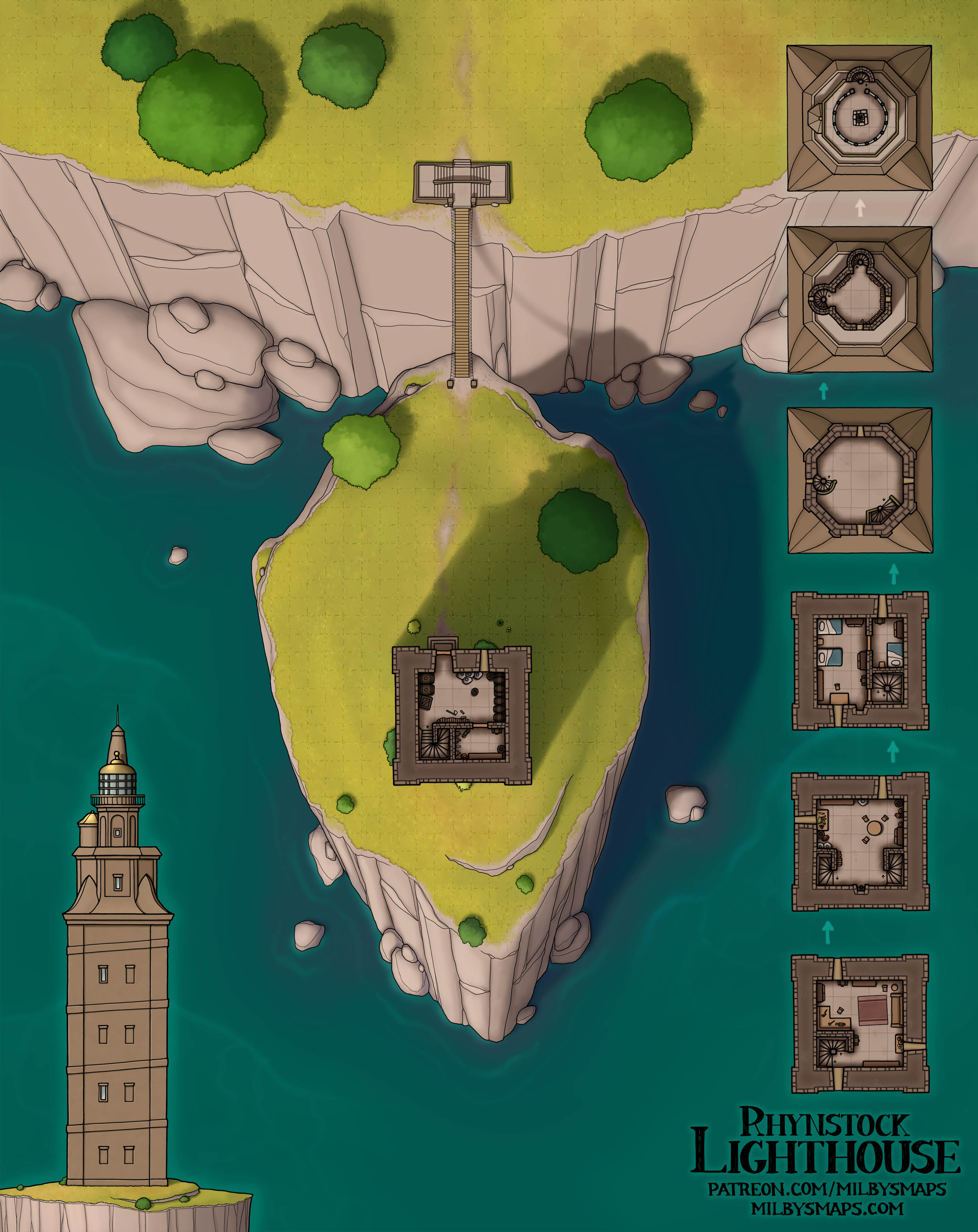
Rhynstock Lighthouse

Those of you from Spain might be thinking this place looks familiar and, yes, this is the Torre de Hércules (Tower of Hercules). Except it isn’t. The Tower of Hercules is an amazingly unique lighthouse, but it has one big problem, which is that it’s a terrible D&D map. The interior is just a staircase. So this is the Tower of Hercules on the outside, but not on the inside.

I was a little conflicted about whether to title this the Tower of Hercules or not, but I decided against it. My longstanding policy is that I only give a map the title of a real place if it’s a reasonably accurate depiction of that place. If I’m using a real place for inspiration, but still getting creative with it, I give it a different name. Still, I try to be as open as possible about my inspiration when I take it from real life. I don’t want to get accused of taking credit for designing any famous landmarks.

Next, I’ll be drawing a great, demonic tower driven into the ground like a giant nail, with only the top floor sticking out. After that, it’s back to drawing more of the Vatican. You know, there’s a nice holy/unholy mix here at Milby’s Maps lately. Widely varying levels of holiness available. I hope everyone’s enjoying that.

Anyway, I’m gonna get started on that demon map. Hope you like the kinda-sorta Tower of Hercules!

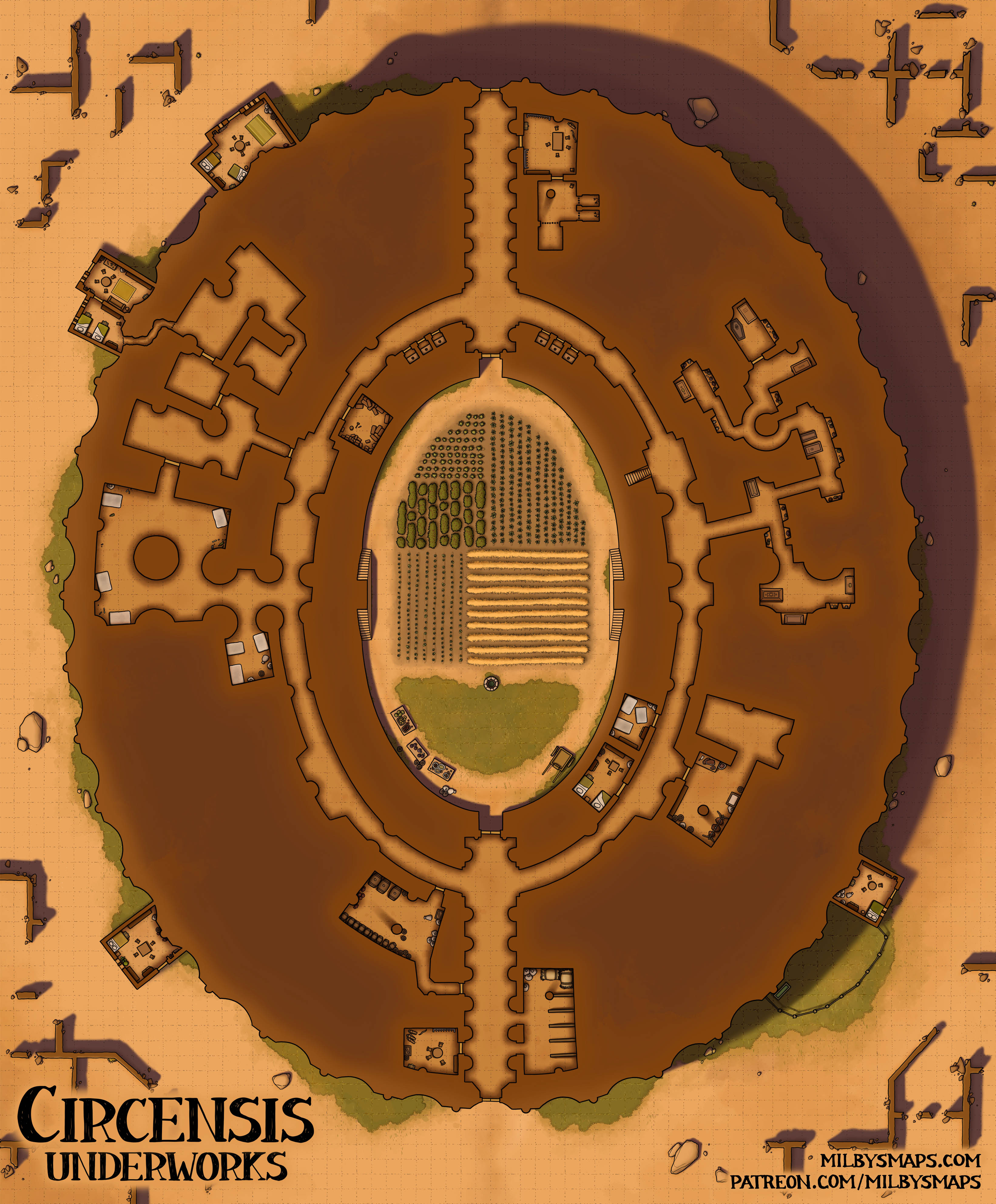
Circensis: The Underworks

Here in the lower level of Circensis, there are some crypts, guard posts, a stable and a few other things. There are also a few disused chambers where the town’s poorest residents sleep.

I added a small tunnel leading into the underworks from the house in the upper left, which I thought might create some interesting possibilities. Maybe the party has to sneak into or out of the town and meets a group of smugglers who know about the passage. Or maybe a group of raiders finds out about it and sneaks in under cover of night. You may not have a use for it, but it’s there if you do.

With Circensis finished, I’ll be getting back to the Vatican. I’ll be drawing the Sacristy next, which is just south of St. Peter’s Basilica. This is where the passages at the bottom of the basilica map lead. Sacred relics were (and are) kept here, as well as the treasury. It also contains the workshops of the Fabbrica di San Pietro, the group of maintainers and restorers responsible for the upkeep of the basilica.

All right, that’s about it for now. Hope you like how Circensis turned out!

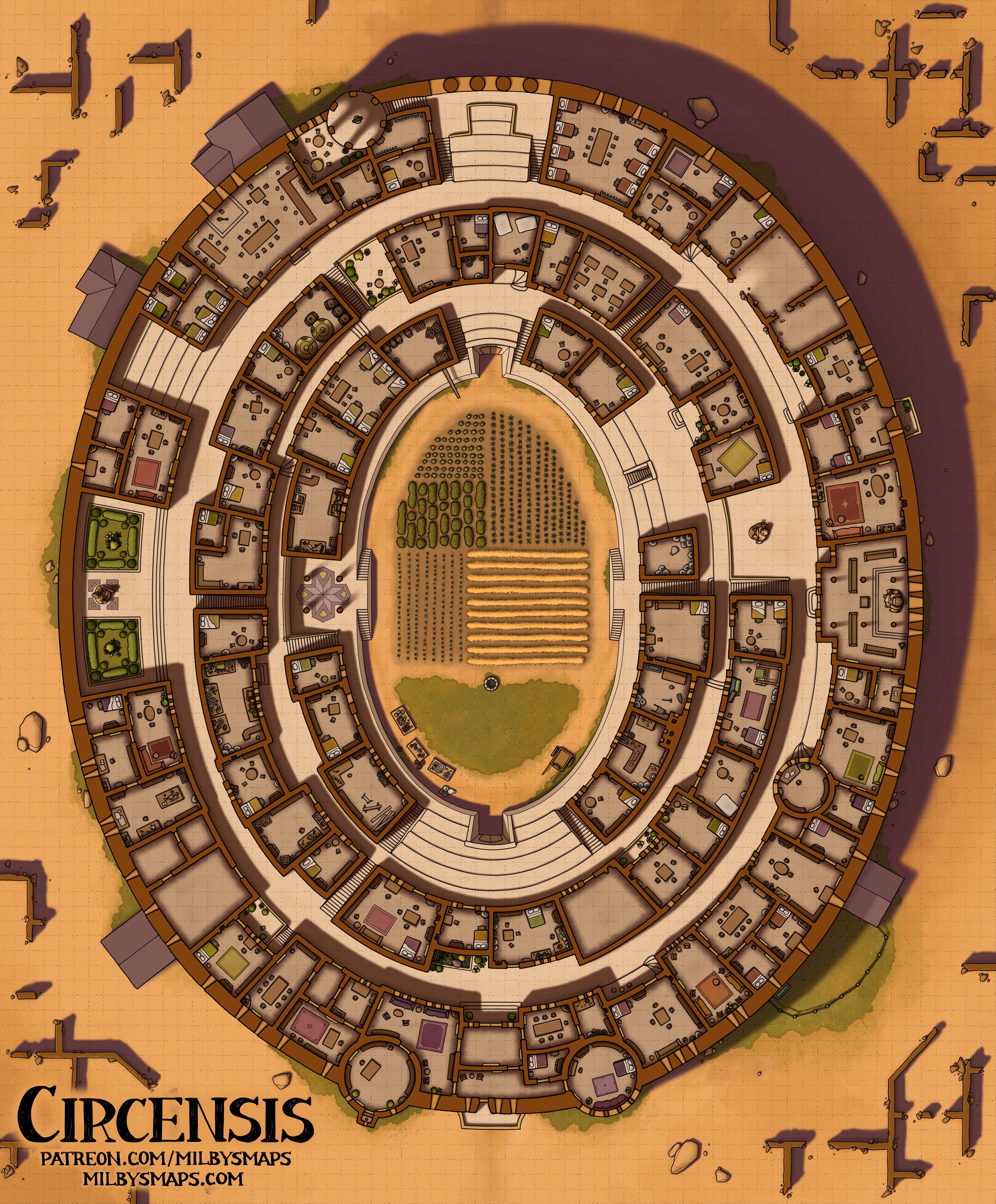
Circensis: A Town Built on the Ruins of an Ancient Amphitheater

Well, this place turned out a bit bigger than I expected, but I think it was worth the effort. I’ll be drawing a map of the underworks next, which won’t be nearly as elaborate as this level, but will have some interesting stuff going on. It’ll also give this place an entrance.

As you can see, some of the amphitheater’s tiered seating still exists, making it clear what this place used to be, although most of it has been leveled off and built over. The walls of the ancient city that this was once a part of are scattered around nearby and were probably picked apart to build the town.

As I said, I’ll be drawing the lower level of Circensis next (and I’ll have DM notes for patrons with that). Then, it’s back to the Vatican. Anyway, this town-built-on-an-amphitheater seemed like a popular idea, so I wanted to ask how you think I did with it. Let me know what you think!

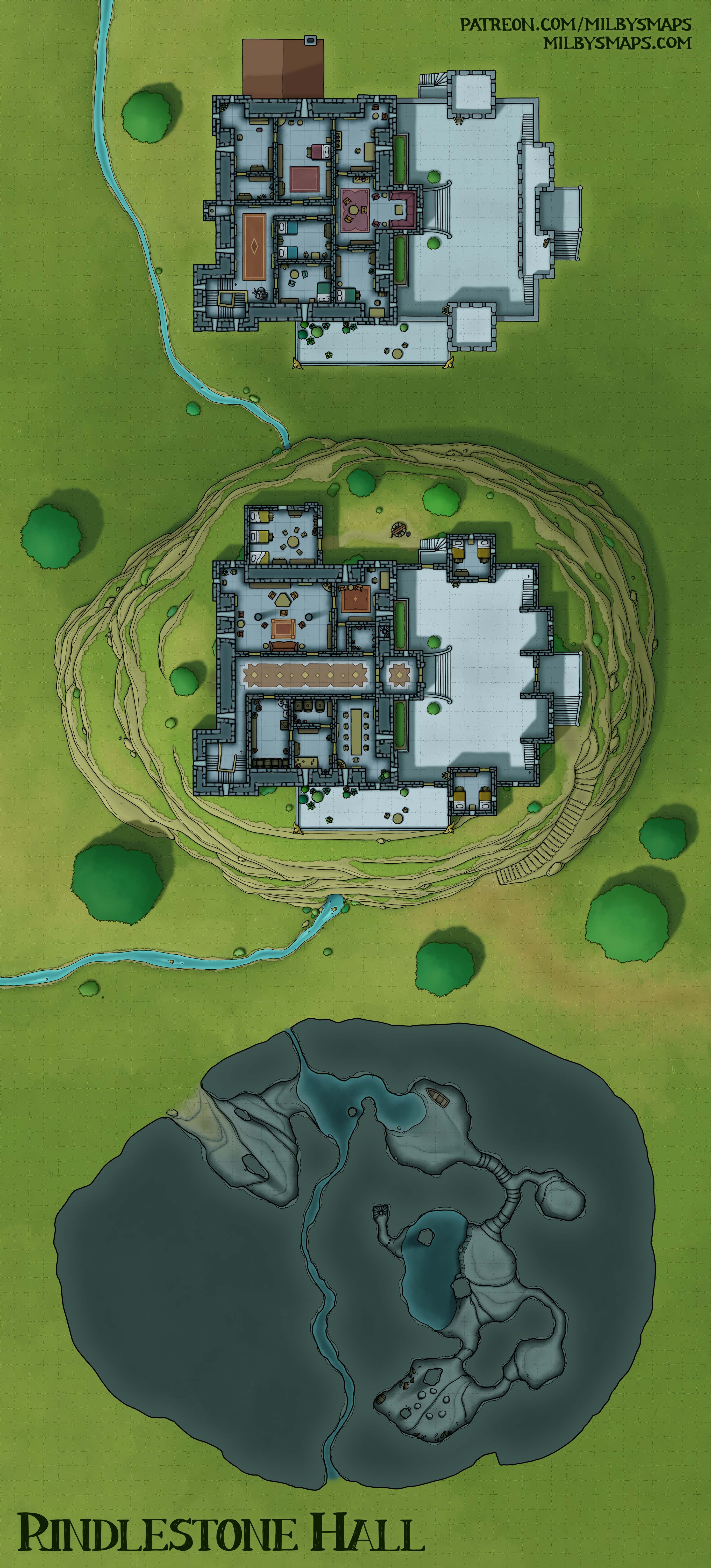
Rindlestone Hall

This map isn’t quite a real place, but it’s strongly inspired by one. Peveril Castle in Derbyshire, England is located over a cave called Peak Cavern, or “the Devil’s Arse.” According to legend, this cave “was where thieves’ cant was created by a meeting between Cock Lorel, leader of the rogues, and Giles Hather, the King of the Gypsies.”

Now, if you’re like me, you just heard a bunch of stuff you didn’t think existed outside of D&D. Thieves’ Cant is a real thing? And there’s a King of the Gypsies?! And– wait, rogues? What else are you hiding, England? Are paladins real, too? Can Anglican priests cast spells? Do your druids shapeshift? I WANT ANSWERS DAMMIT.

Okay, okay, I’m calm. Look, I just wasn’t expecting to learn that rogues and Gypsy Kings were inventing real-life Thieves’ Cant in a cave underneath a castle. I thought the most D&D thing in English maybe-history was Robin Hood and this kind of blows that away. Wow.

So, next up, I’ll be drawing the last part of St. Peter’s Basilica: the reliquary lodges. These are located inside the four main columns around the center of the basilica, so they’re pretty small and should only take a couple days to finish. I’ll say more about them when I’m done.

All right, I’m gonna get to it. See you soon!

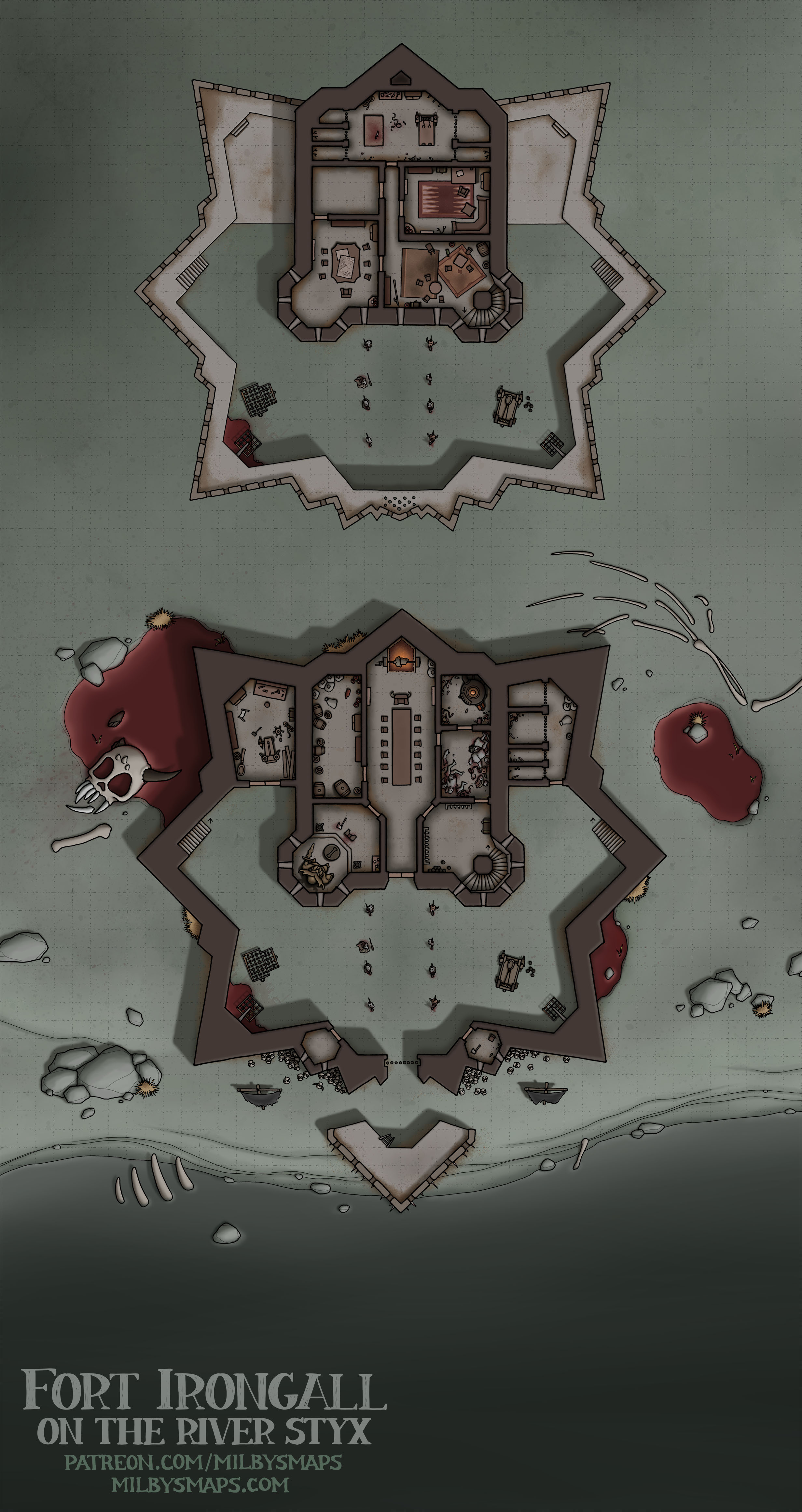
Fort Irongall on the River Styx

Hell. Hell never changes. Wait, that’s war. Does hell change? I’m not sure. In the traditional D&D cosmology, there are nine hells and they’re all different, so I think we can conclude that hell does, in fact, change. In a sense, anyway.

With that settled, I’m curious what you think about my depiction of hell. We’ve got the River Styx, some pools of blood (which I imagine is what it rains in hell), and a variety of skulls, corpses, heads on poles and so on. I wanted to draw something a little different from the standard-issue “pit of fire,” but I wasn’t trying to completely reinvent hell. Anyway, I hope it works for you.

With this done, we’re back to our regularly scheduled maps of Vatican City. I’ll be drawing the Roman Necropolis next, which is the second-to-last part of St. Peter’s Basilica. That’ll be three maps in a row with quite a lot of death in them. I hope you guys like death. Any death fans out there? Let’s hope so. Anyway, I’m gonna go look up some floor plans for that and get to it. See you soon!

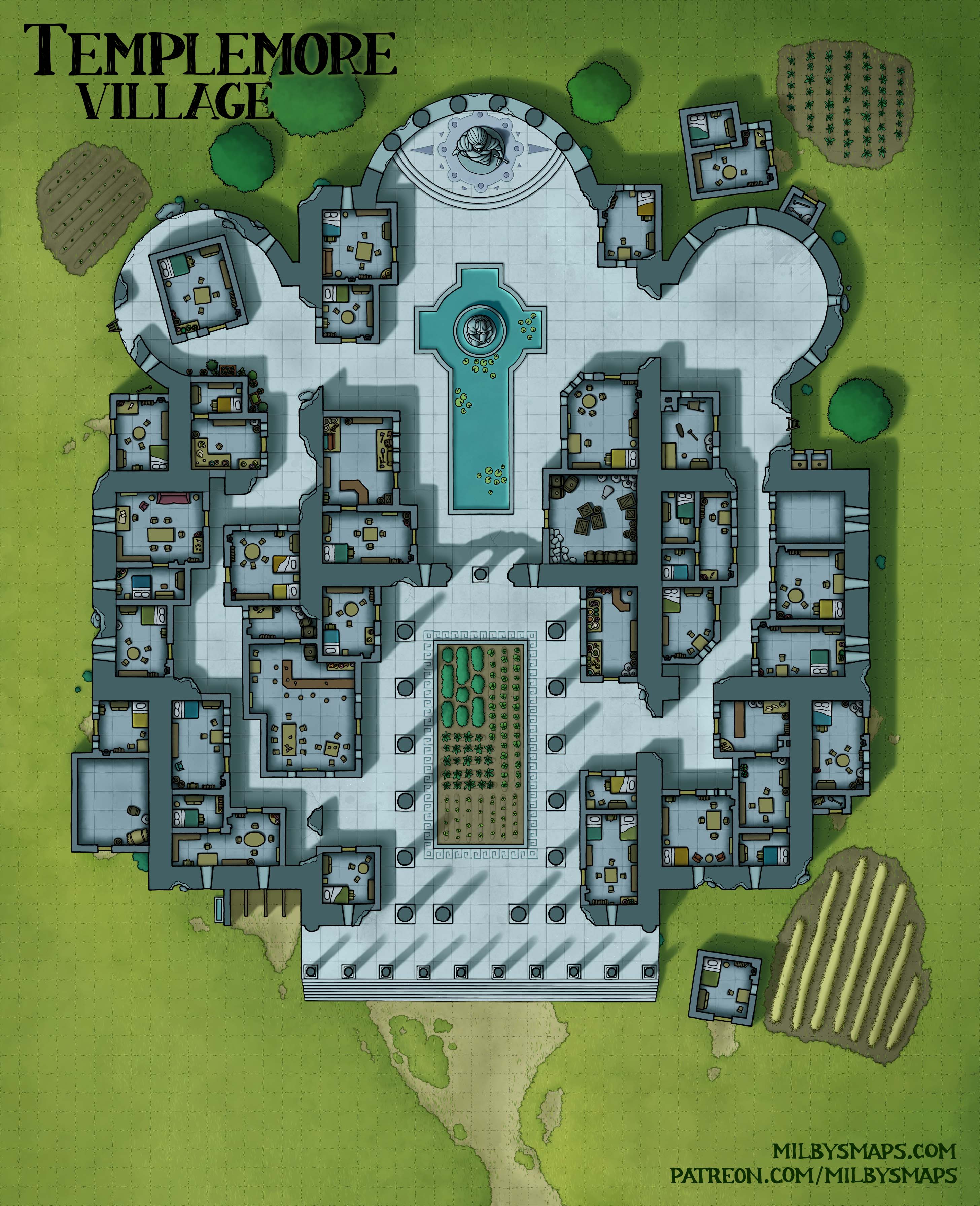
Templemore Village

Here’s the finished village of Templemore, built on the ruins of a great, ancient temple. My story about the place is that the temple was dedicated to a long-forgotten goddess of luck. While the residents don’t worship her (or even know who she is), she bestows her blessing of good fortune upon them nonetheless. So if the players show up at the tavern and start gambling with the old fellas at the corner table, things are likely to go very poorly for them.

There are variations of that story that could be fun, too. If you change the goddess and the blessing, there are a lot of potentially interesting scenarios that could become the seed for an adventure. Like, what if it’s the goddess of time and she stops the residents from aging. Or what if it’s the goddess of death and everyone rises from the dead after they die. Or what if the goddess is angry that they’re here and curses them instead. There are a lot of ways you could go with it if you want to get creative.

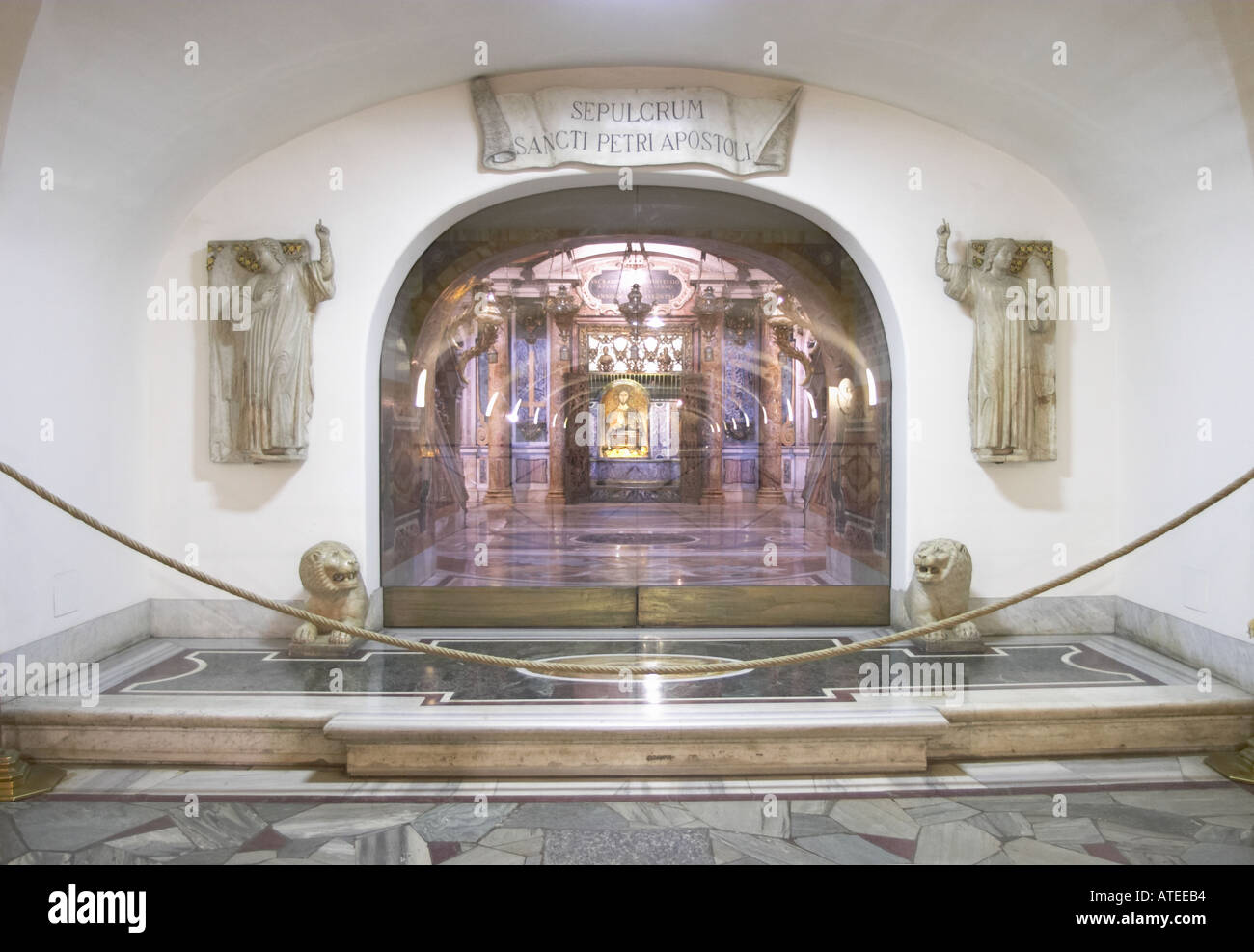
Next up, I’ll be drawing the Vatican Grottoes underneath St. Peter’s Basilica. These are a series of tunnels, chapels and tombs, including the tomb of St. Peter himself. This won’t take nearly as long as the main floor of the Basilica itself, but, as you can see in this picture, they went pretty hard on both the floors and the statuary, so it’ll take a bit longer than it would have if the Vatican had hired a cheaper contractor. Also, I want to add that I love statues of animals by sculptors who’ve never seen that animal in real life and the lions in that picture are a great example.

Anyway, I think that’s about it. I hope you like the map. Let me know what you think!

The Town of Chalymn

Chalymn is a small chunk of a city on the world’s surface that rose up into the sky to avoid a coming disaster. The large citadel in the center belongs to Magister Viskand, the powerful mage who ripped Chalymn loose from the earth. It’s not entirely clear if the magister saved everyone else on the rock intentionally, or if he just wanted to bring a little more land with him, but, look, they’re alive and that’s what matters.

If Chalymn demonstrates one thing, it’s that a little, floating rock in the sky can have anything that they have on the surface. The surface has lakes? Chalymn has a lake. The surface has a complex network of tunnels and cities deep underground? Well, Chalymn has one of those, too. It could be a very interesting place to visit if your party happens to get a ride on an airship at some point. Or a spelljammer.

Speaking of which, I’m going to make a spelljammer version of the map with a space background for patrons, which I should have done by tomorrow.

Well, this is the second, or maybe third city map I’ve drawn that I don’t think is garbage, but I’m curious to hear what you think. How’d I do? If you’ve got any thoughts or suggestions, let me know!