The Grinning Widow: A Ship for the Seas of the Underdark

The Grinning Widow is a ship designed for the Black Loch. In an underground sea, sails aren’t going to accomplish much, so the Widow doesn’t have any. She’s a galley, powered exclusively by rowing, with a crew of 20 oarsmen who all look like they walked out of a “skipped leg day” meme.

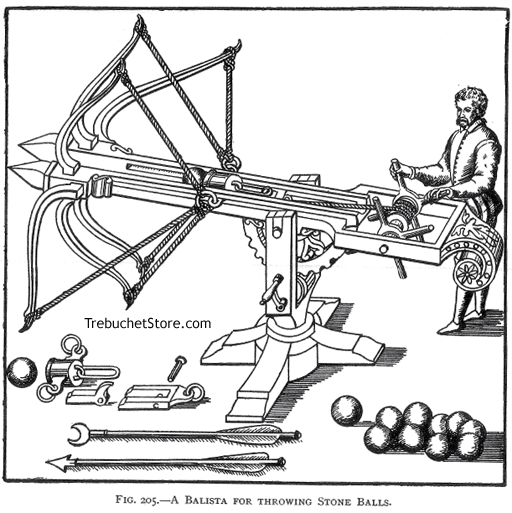
For defense, the Widow is armed with a ram on the bow, as well as two ballistas, one of which is a little scarier than the other. You see, I’ve been drawing the “big crossbow” ballista in my maps for a while now, but I wanted to change things up a bit, so I started searching for different ballista designs. I found a few I liked, but then– out of nowhere– this thing struts into the room. Yes please.

I don’t know if it’s real and I don’t care. It’s awesome and I decided it was definitely going in the map. I made a token of it, too, by the way, as well as the other one. You can get them both here. Personally, I’d give it around double the range and damage of a regular ballista in the DM’s Guide, but require a 2-person crew to fire it every round. And give it +1 to damage if the party names it.

So, here’s a funny story from my game. A few years ago, my players spent some time on a ship like this one, down in the underdark. The orog crew ended up teaching them Orcish, which my wife’s elven wizard got quite good at.

Several months later, she’s with a different party, being confronted by orc bandits, and she uses her knowledge of Orcish to speak with them.  The bandits look at each other and burst out laughing, which leaves the party confused. Finally, the orc leader stops laughing and tells her he’s never heard an elf in a fancy dress speaking Orcish. And he never imagined that, if he did, she’d be speaking the filthiest Orcish he’s ever heard.

They end up eating with the orcs, who tell her that everything she says is heavily laced with curse words. She hadn’t realized it, but the orog sailors taught her to speak like they do, which is very crudely, even by Orcish standards. So she knows the language, but she can’t speak it without cursing. Fortunately, orcs don’t tend to be prudish about that kind of thing, but no one expects it from someone like her.

Anyway, next up, I’ll be drawing a mountainous island settlement. And after that, I’ll be coming back to draw something else from the Black Loch. Maybe the illithid ruins? We’ll see.

Well, I’m gonna grab some coffee and start sketching some islands. Let me know what you think of the Widow!

There’s an annotated version of this map and DM notes available to patrons.

The Smoldering Abyss

Here’s an alternate version if you’d prefer the place dried out.

The Smoldering Abyss is a part of the Black Loch almost no one even knows exists. It’s a deep, underwater trench at the bottom of a larger underwater trench at the bottom of the loch. And, in a place where no one even wants to think about what might be under the surface of the sea, places like this tend to go unnoticed.

There are three things of note here. The first is an ancient, kuo-toan royal catacomb. Built thousands of years ago, before the kuo-toa became… let’s say “psychologically non-conformist,” it was a place where they buried their kings.

The second thing is a monster called “the Whisperer.” It’s a huge, black beast with rubbery tentacles and a wide, fanged mouth like an anglerfish. While not as big as a kraken, it’s more than big enough to scare the hell out of the sailors of the Black Loch. Fortunately for the sailors, the Whisperer hasn’t been seen in almost 250 years and many believe it to be dead. Unfortunately, they’re wrong and it’s not. It’s hibernating here and it’s about to wake up.

Finally, there are the smoking rocks. Those are a type of hydrothermal vent known as a black smoker. They’re like tiny, underwater volcanoes that pump boiling hot water filled with minerals into the sea and are usually found around 3km below the surface. If you’re planning to use the map, keep in mind that those vents would actually make the water fairly warm here. And they’d burn anyone who got too close pretty badly.

With another Black Loch map down, I’m going to spend the rest of the day drawing some tokens, which I should have for you sometime tomorrow. After that, I want to check another Black Loch map off the list. I’m not sure which one, but I’ll let you know in the next post. Then, I’ll be drawing last month’s Cartographic Congress winner, a mountainous island settlement.

Anyway, that’s the plan for now. Let me know what you think of the abyss!

There are DM notes for this map available to patrons.

Fort Bourtange – Roof Level and Dutch Version

Here’s the roof level, which is the last part of Fort Bourtange. I also made something else: an annotated version in Dutch, which I’m giving out to everyone.

I’m aware that everyone in the Netherlands under the age of 105 speaks perfect English along with 50 other languages, so I know you probably don’t need this, but I still thought it’d be nice to do. Plus, the English version comes from a Dutch tour map I translated, so I figured I could just not translate it and make a Dutch version that way. There are a couple things I had to use Google for, so I can’t promise it’s perfect, but let me know if anything is wrong or just super weird and I’ll fix it.

Anyway, the next map will be a demonologist’s lair, Remember A Dark Place? I’m gonna try to make someplace freakier than that. It’s not Hell, but it’s the home of… well, a big fan of Hell. A Hell stan, if you will. Hopefully I can come up with something uniquely terrible.

I’ve also got the next historical map picked out, which I’ll be doing sometime in the next few 2-3 months. This time, I’ll be drawing a place in Britain– or, more specifically, Scotland. There are some incredible places in Scotland, like Stirling Castle, the Wallace Monument, and about half the buildings in Edinburgh. Instead of drawing any of that stuff, I’m going to draw Coxton Tower. It’s a towerhouse in Moray and I think it’d make a great map. It’s not huge, complicated or flashy, but it’s interesting. It’s got some unique character, both inside and outside, and it’s the kind of place everyone can find a use for.

I don’t know exactly when I’ll start on it, but I definitely want to put some work in on the Black Loch first. That’s Scottish, too. Well, a little. I mean, it’s not the Black Lake. Anyway, I’m gonna go sketch out some freaky demon stuff. If you’ve got any thoughts on any of this, let me know!

Fort Bourtange

In the 1500s, the Netherlands were ruled by the Habsburgs. The Habsburgs were an astoundingly inbred German noble family with faces that were about 85% chin. For some reason, they were the rulers of the Spanish Empire.

The people of the the Low Countries didn’t want to be ruled by German people, Spanish people or inbred people, let alone a combination of the three. They wanted self-determination, a republic and the right to worship the protestant version of God. So, in the mid-1500s, the Dutch Revolt began.

The Spanish Empire ruled Spain, part of Italy, Austria, and– you know the countries that speak Spanish today? All of those. It was a daunting enemy, but the Low Countries had one thing going for them: stupefying amounts of money. And they planned to leverage that to win.

One of the things the Dutch spent that money on was Fort Bourtange. Since the Spanish were allied with the Holy Roman Empire, they’d need a way to protect the Dutch land from the Deutschland. One of the main roads to Germany passed through a marsh, so the leader of the revolt, Willem van Oranje, ordered the construction of a fort across it.

Building a star fort with forty buildings, a crownwork, four ravelins and two moats is an expensive operation. But not only did they build it, they built it on a sandbar in the middle of a marsh.

Fort Bourtange was such an obvious deathtrap that not many people were inclined to order their armies to assault it. But, about 100 years after its construction, Bernhard von Galen, the Prince-Bishop of Münster, came along to give it the old college try. During a parley before the attack, he told the fort’s commander, Captain Protts, he had 200,000 guilders for him if he’d surrender Bourtange. Protts famously responded by telling von Galen he had 200,000 bullets for him and his men. Von Galen decided to send his soldiers to go receive them, which resulted in a crushing defeat for his army. He then went on to besiege the nearby city of Groningen, which he also failed at.

In later years, the fort began to transition into a village, where the soldiers of the garrison lived with their families. Then, in the 1800s, the fort was turned into a village for local farmers.

Well, this map was a ton of work, but I hope you like it! I’m going to make a roof-level version of the fort next, which should only take a couple days, then I’ll be moving on to the next map. I plan to make a big push on getting some Black Loch maps done over the next few months as well.

Anyway, let me know what you think of Fort Bourtange!

There’s an annotated version of this map and DM notes available to patrons.

Gamblers’ Key – A Pirate Fortress and Casino

Here’s the unfurnished version of this map.

Gambler’s Key is a pirate lord’s fortress with a casino in the front and a loading bay for pirates to drop off their plundered cargo in the rear. It’s sort of the opposite of a mullet: a party in the front, business in the back. Well, I guess it depends which side you consider the front, but… whatever, let’s not overthink it.

Ryan, who proposed this map to the Cartographic Congress, asked me to make a token of this as well. Basically, the token is for inserting the island onto a sea map in which the party’s ship is 1-2 tiles in size. Anyway, you’re all welcome to it as well and you can download it here.

The other week, I talked about drawing a map of Fort Bourtange, a star fort in the Netherlands. I want to get that started fairly soon, so here’s the plan: I want to get a Black Loch map drawn this month, so I’m going to do that next. I’ll be drawing the “secluded manse,” which is the home of a powerful wizard living on the island of Driders’ Rock.

After that, I’ll be drawing last month’s Cartographic Congress winner: a floating, thirteen-level tower dedicated to magical experiments and research with a dock for airships. And then I’ll be drawing Fort Bourtange. I’d like to get started on it around the beginning of next month, but we’ll see how long the other two maps take. Sound good? I hope so.

Anyway, let me know what you think of Gamblers’ Key!

There’s an annotated version of this map and DM notes available to patrons.

The Torrents

I’m giving out all the patron content for this map to everyone. You can download it from my Google Drive here. I’ve also put it in the public Foundry module (manifest URL).

The Torrents are one of the ways to reach the Black Loch from the surface, starting as an above-ground river and turning into a series of cascading waterfalls going deeper and deeper underground.

As an entrance to the underdark, I like this for a few reasons. First, it’s fast. There’s no three-day journey down the stairs. Your party can make it into the bowels of the earth in around an hour. Second, it’s super dangerous. There’s no better way to emphasize the perils of the underdark than nearly killing half the party on the way there. Also, it’s one-way, which is nice. No DM wants to write a whole campaign and then have the PCs decide the underdark “isn’t for them.”

There’s also an interesting possibility with the Torrents that I’ve been thinking about: you can have the party enter the underdark accidentally. I wrote a few ideas about how you might go about doing that in the DM notes, if you’re interested. Personally, if I were going to send a party in like that, I’d wait until a big part of the campaign had just concluded. Then, just as they’re heading down the river to meet the king and collect their heaping mountain of gold bars…

“A loud crash wakes you up in your hammocks. The boat appears to be falling.”

I’m not saying you should do that, I’m just… I’m not saying you should not do it. It would be really funny, though.

Next up, I’ll be drawing a map chosen by the Cartographic Congress: a mountain monastery clinging to a cliffside with a waterfall running past. This will be based partly on Paro Taktsang, a Buddhist monastery in Bhutan. There’s something I love about places built in really dangerous locations.

After that, I’ll probably do another map from the Black Loch. I’ve been thinking about adding a location to the loch map based on something from my previous campaign. It’s a duergar cult called the Architects of the Awakening and they’re up to some pretty twisted stuff. The campaign never finished, but I think it’d be pretty cool to put the bad guys in the Black Loch and see if anyone else wants to do something with them.

Anyway, that’s about it. Let me know what you think of the Torrents!


The Benthic Academy: An Undersea Ruin

Here’s another version of the map with air pockets in some of the rooms.

When I draw a ruin, I like to trash the place. I don’t want it to just be a building with holes in the walls, I want it to look like a hotel room the Rolling Stones spent the night in in 1976.

In this particular map, however, some parts are less trashed than others. That’s because the Benthic Academy is a college of magic– or, at least, it was until whatever disaster swept it under the waves. Unlike most places, the academy has magical wards holding some of it together, particularly the library (on the right), the faculty rooms (bottom center), and the dean’s residence (upper left).

The wards were meant to prevent cracked walls, broken windows and leaks, but they’ve done such a great job that, even after years underwater, a lot of the academy is still in one piece. Depending on which version of the map you use, they may have even caused a few of the upper-level rooms to retain air pockets.

If you might be using this map, I’ve got a few suggestions. First, I’d recommend considering your party’s underwater capabilities when planning encounters. Keep in mind that most melee weapons roll with disadvantage underwater. And, even if your players stop to re-equip themselves at Tridents-R-Us, you may need to consider how dependent they are on any magic weapons they won’t be using. If that Hammer of Hit Point Obliteration is doing a lot of work, you may want to dial the enemies back a little. Also, remember that Lightning Bolt and Fireball aren’t really on the menu anymore.

Second, I’d start the party out on the roof level. Since they’re swimming down into this, that’s the first thing they’ll see.

And finally, if the spellcasting PCs can’t cast Water Breathing enough times to  get the whole party down there, just put a few potions of water breathing into the loot of the adventure before this one. Don’t worry, handing out suspiciously convenient water breathing potions before an underwater quest is an ancient DM tradition.

Next up, I’ll be drawing another map from the Black Loch: the surface entrance. This isn’t a stairway, it’s a series of waterfalls, and it’s probably the quickest way into the Underdark from the surface. Is it the safest way? Probably not, but that’s your party’s problem. Also, since this entrance presumably leads down from a river on the surface, it allows for the possibility of traveling to the Underdark accidentally. And the best part: it’s one-way.

Anyway, I’m gonna start sketching that out. Let me know what you think of the Benthic Academy!

There’s an annotated version of this map and DM notes available to patrons.

The Château de Chenonceau

God the French make some cool stuff. “Let’s just build it over the river.” Sure, why not, here’s money, let’s do it. Amazing.

While I was researching this place, I learned a bit about the castle’s most famous resident, Catherine de Medici. She was the queen of France in the mid-1500s, who later ruled the country as Queen Regent after her husband died. She was also a woman who liked to party and, by all accounts, she threw a GREAT one. There’s actually a wikipedia page specifically about her parties. Parties that happened 500 years ago. Let me go ahead and quote that for you:

Catherine arranged entertainments that lasted for several days, including fancy-dress jousting and chivalrous events in allegorical settings. On Mardi Gras, the day after the banquet in the meadow, knights dressed as Greeks and Trojans fought over scantily clad damsels trapped by a giant and a dwarf in a tower on an enchanted island. The fighting climaxed with the tower losing its magical properties and bursting into flames.

Sure, you know, typical Saturday for me too. She also put on the first fireworks display in France, as well as– at least once– a party where the food was served by topless women. Keep in mind that this was the 1500s. At a time when they would light you on fire if they thought you were a witch, this lady was running strip shows. Wild.

Anyway, I know a lot of people were looking forward to this map, so I hope it’s everything you were hoping for! I’m planning to do some more historical maps before too long, but next I’m going to return to the Black Loch. I’ll be drawing the myconid colony next, then I’ll be drawing the next Cartographic Congress map: the underwater ruins of the Benthic Academy, an ancient college of magic. After that, I’ll probably be getting back to the Black Loch again, since I want to make some more progress on that. In any case, I’ll be drawing more of the loch over the next couple months.

Well, I’m gonna start drawing some mushrooms. Let me know what you think of the Chateau!

An annotated version of this map and DM notes are available to patrons.


The Cobalt Flotilla: The Ships

Turtle Ship
Barge
Drua

And the rest:

I don’t often post 11 maps in one day. It feels like a lot, even if I did make those 11 maps for the purpose of making one big map. Anyway, I hope everyone’s good on ships for a while, because after drawing all these, it might be a minute before I do another one.

In any case, I’d say everyone’s collection of ship maps just got a lot more diverse. You’ve got three Japanese ships, a Korean ship, a Filipino ship, a Portuguese ship, a Fijian ship, a few kinda-sorta Chinese boats and a Polynesian raft. Hopefully they make your seafaring campaigns a bit more interesting.

All right, next up is the Château de Chenonceau, a magnificent French castle built across a river. Imagine the Twins from Game of Thrones, except they were an only child. And a lot classier. I’ve been looking forward to drawing it since I found the floor plans and I’m going to get to work the second I stop typing.

Well, I hope everyone likes the flotilla! It took a lot longer than I expected, but I think it turned out really well and there are a lot of possibilities for how to use it. Overall, I’d say it was worth it and, hopefully, most of you agree.

One last thing: I’d like to apologize for mentioning Game of Thrones. It’s been two years since season 8, but for some of you it may still be too soon. Stay strong, we’ll get through this together.

The Cobalt Flotilla: Oscar Mike

Here’s the flotilla on the move. They’re keeping a pretty tight formation, but this is a pretty big map as it is and, if I spread the ships out much more, it would have ended up with a grid size of OMGxWTF.

Some of you might end up using the flotilla and you may want to run a naval battle. I say “may,” but, I mean, let’s be real: it’ll happen. Anyway, I’ve got you covered: here’s the Cobalt Flotilla Showdown Map. Good guys on the top, bad guys on the bottom. Unless the flotilla are the bad guys, in which case… look, I’ll let you figure it out.

Anyway, the last thing to do is make individual maps of the ships. That shouldn’t take me long, so I’d say it’ll be done in a day or two.

One last thing: you might be wondering why it’s called the Cobalt Flotilla. This map was chosen by the Cartographic Congress. Jon, who proposed it, explained to me that he was planning to populate it with kobolds, who come from German folklore, and that the word “cobalt” derives from “kobolds.” Thus, the “Cobalt Flotilla.”

I don’t know about you, but I didn’t even know kobolds were a thing outside of D&D. Now that I do, I can promise you one thing: from here on, all kobolds in my game will have German accents. I wouldn’t want to be historically inaccurate.