The Grinning Widow: A Ship for the Seas of the Underdark

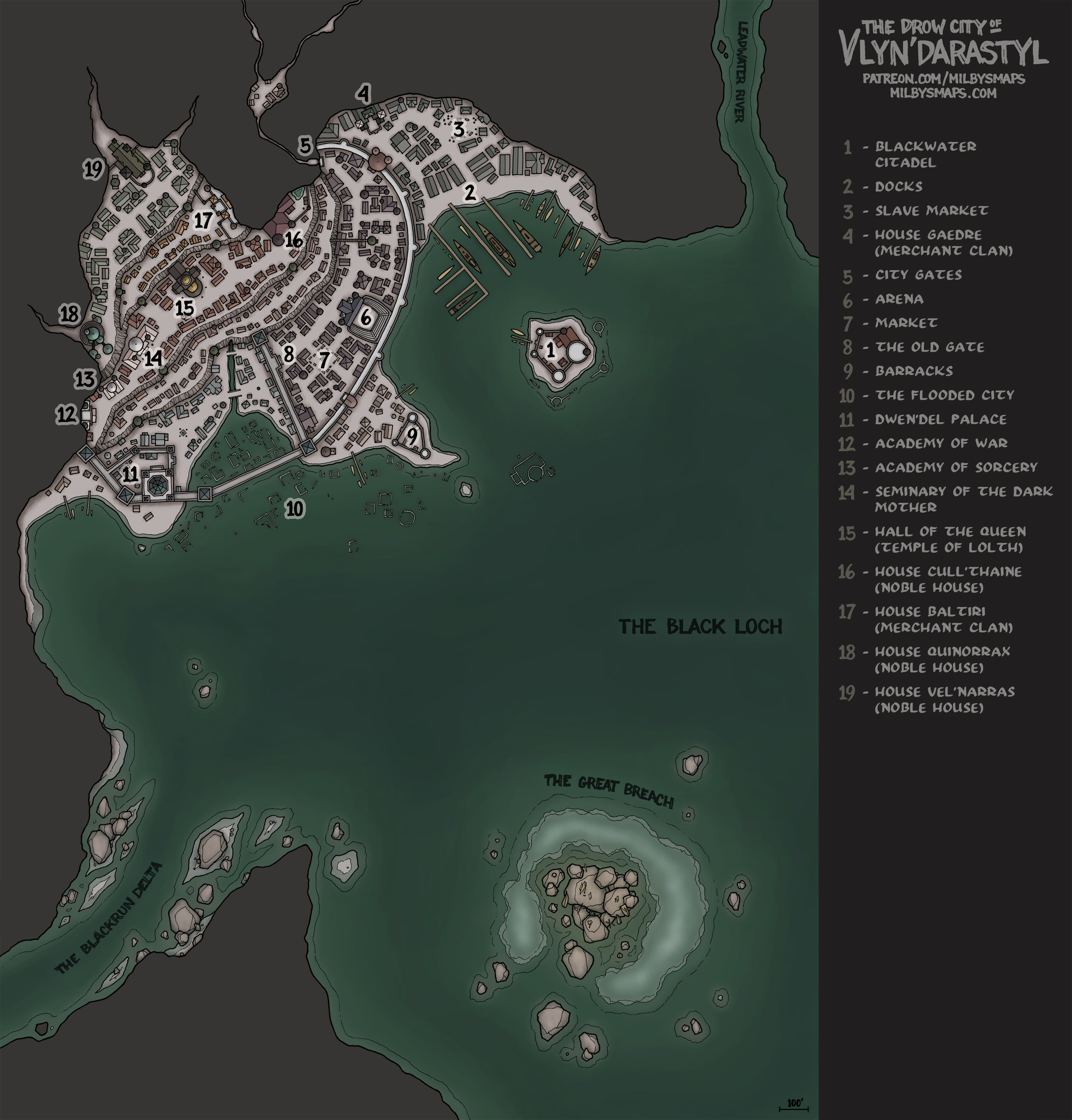
The Grinning Widow is a ship designed for the Black Loch. In an underground sea, sails aren’t going to accomplish much, so the Widow doesn’t have any. She’s a galley, powered exclusively by rowing, with a crew of 20 oarsmen who all look like they walked out of a “skipped leg day” meme.

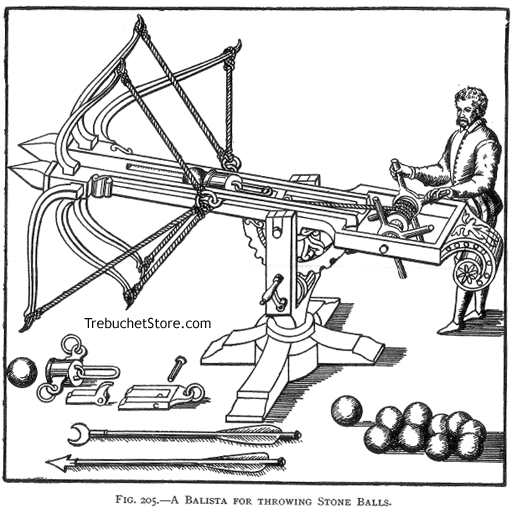
For defense, the Widow is armed with a ram on the bow, as well as two ballistas, one of which is a little scarier than the other. You see, I’ve been drawing the “big crossbow” ballista in my maps for a while now, but I wanted to change things up a bit, so I started searching for different ballista designs. I found a few I liked, but then– out of nowhere– this thing struts into the room. Yes please.

I don’t know if it’s real and I don’t care. It’s awesome and I decided it was definitely going in the map. I made a token of it, too, by the way, as well as the other one. You can get them both here. Personally, I’d give it around double the range and damage of a regular ballista in the DM’s Guide, but require a 2-person crew to fire it every round. And give it +1 to damage if the party names it.

So, here’s a funny story from my game. A few years ago, my players spent some time on a ship like this one, down in the underdark. The orog crew ended up teaching them Orcish, which my wife’s elven wizard got quite good at.

Several months later, she’s with a different party, being confronted by orc bandits, and she uses her knowledge of Orcish to speak with them.  The bandits look at each other and burst out laughing, which leaves the party confused. Finally, the orc leader stops laughing and tells her he’s never heard an elf in a fancy dress speaking Orcish. And he never imagined that, if he did, she’d be speaking the filthiest Orcish he’s ever heard.

They end up eating with the orcs, who tell her that everything she says is heavily laced with curse words. She hadn’t realized it, but the orog sailors taught her to speak like they do, which is very crudely, even by Orcish standards. So she knows the language, but she can’t speak it without cursing. Fortunately, orcs don’t tend to be prudish about that kind of thing, but no one expects it from someone like her.

Anyway, next up, I’ll be drawing a mountainous island settlement. And after that, I’ll be coming back to draw something else from the Black Loch. Maybe the illithid ruins? We’ll see.

Well, I’m gonna grab some coffee and start sketching some islands. Let me know what you think of the Widow!

There’s an annotated version of this map and DM notes available to patrons.

Altar of the Black Lamb

This map was the demonologist’s tower chosen by the Cartographic Congress. One of the stipulations was that it would have a portal to hell and I decided to go a little… non-traditional with that. “Traditional,” in this case, would be your standard-issue Door of Fire. And the problem I have with that is that it’s boring. It’s been done and it’s not scary. It doesn’t give players the sense of fear they should feel when they’re about to travel to a place where literally everybody wants to torture you to death.

So I came up with something else: a black void in the chest cavity of a rotting, dismembered storm giant. It’s the most awful thing I could think of and, to me, it’s the kind of welcome mat Hell needs. And, since “Create a Permanent Gate to Hell” isn’t a spell in the Player’s Handbook, who’s to say it doesn’t require a dead giant as a component?

I think it works pretty well in the other direction, too. If the plan is for something to come out of the portal to attack the party, it’s going to be a lot scarier after pulling itself up out of that thing. Imagine a pit fiend coming out of there. Imagine narrating that. Holy crap.

Next up, I’ll be drawing a map from the Black Loch. I want to get some serious work done on the Loch over the next few months and I’m going to start with the Abyssal Caverns, a series of caves and tunnels in the sides of a deep, underwater crevasse. I don’t have too much of a plan yet, but there will probably be a kraken’s lair.

Also, I wanted to say one last thing to the old school DMs out there. If you played D&D in the 80s or 90s, imagine using this map and your parents walked in and saw it. They’d be like, “I knew it! I knew you were worshipping satan!” Haha, oh man. I’m glad that’s not a thing anymore.

There’s an annotated version of this map and DM notes available to patrons.

Fort Bourtange – Roof Level and Dutch Version

Here’s the roof level, which is the last part of Fort Bourtange. I also made something else: an annotated version in Dutch, which I’m giving out to everyone.

I’m aware that everyone in the Netherlands under the age of 105 speaks perfect English along with 50 other languages, so I know you probably don’t need this, but I still thought it’d be nice to do. Plus, the English version comes from a Dutch tour map I translated, so I figured I could just not translate it and make a Dutch version that way. There are a couple things I had to use Google for, so I can’t promise it’s perfect, but let me know if anything is wrong or just super weird and I’ll fix it.

Anyway, the next map will be a demonologist’s lair, Remember A Dark Place? I’m gonna try to make someplace freakier than that. It’s not Hell, but it’s the home of… well, a big fan of Hell. A Hell stan, if you will. Hopefully I can come up with something uniquely terrible.

I’ve also got the next historical map picked out, which I’ll be doing sometime in the next few 2-3 months. This time, I’ll be drawing a place in Britain– or, more specifically, Scotland. There are some incredible places in Scotland, like Stirling Castle, the Wallace Monument, and about half the buildings in Edinburgh. Instead of drawing any of that stuff, I’m going to draw Coxton Tower. It’s a towerhouse in Moray and I think it’d make a great map. It’s not huge, complicated or flashy, but it’s interesting. It’s got some unique character, both inside and outside, and it’s the kind of place everyone can find a use for.

I don’t know exactly when I’ll start on it, but I definitely want to put some work in on the Black Loch first. That’s Scottish, too. Well, a little. I mean, it’s not the Black Lake. Anyway, I’m gonna go sketch out some freaky demon stuff. If you’ve got any thoughts on any of this, let me know!

Fort Bourtange

In the 1500s, the Netherlands were ruled by the Habsburgs. The Habsburgs were an astoundingly inbred German noble family with faces that were about 85% chin. For some reason, they were the rulers of the Spanish Empire.

The people of the the Low Countries didn’t want to be ruled by German people, Spanish people or inbred people, let alone a combination of the three. They wanted self-determination, a republic and the right to worship the protestant version of God. So, in the mid-1500s, the Dutch Revolt began.

The Spanish Empire ruled Spain, part of Italy, Austria, and– you know the countries that speak Spanish today? All of those. It was a daunting enemy, but the Low Countries had one thing going for them: stupefying amounts of money. And they planned to leverage that to win.

One of the things the Dutch spent that money on was Fort Bourtange. Since the Spanish were allied with the Holy Roman Empire, they’d need a way to protect the Dutch land from the Deutschland. One of the main roads to Germany passed through a marsh, so the leader of the revolt, Willem van Oranje, ordered the construction of a fort across it.

Building a star fort with forty buildings, a crownwork, four ravelins and two moats is an expensive operation. But not only did they build it, they built it on a sandbar in the middle of a marsh.

Fort Bourtange was such an obvious deathtrap that not many people were inclined to order their armies to assault it. But, about 100 years after its construction, Bernhard von Galen, the Prince-Bishop of Münster, came along to give it the old college try. During a parley before the attack, he told the fort’s commander, Captain Protts, he had 200,000 guilders for him if he’d surrender Bourtange. Protts famously responded by telling von Galen he had 200,000 bullets for him and his men. Von Galen decided to send his soldiers to go receive them, which resulted in a crushing defeat for his army. He then went on to besiege the nearby city of Groningen, which he also failed at.

In later years, the fort began to transition into a village, where the soldiers of the garrison lived with their families. Then, in the 1800s, the fort was turned into a village for local farmers.

Well, this map was a ton of work, but I hope you like it! I’m going to make a roof-level version of the fort next, which should only take a couple days, then I’ll be moving on to the next map. I plan to make a big push on getting some Black Loch maps done over the next few months as well.

Anyway, let me know what you think of Fort Bourtange!

There’s an annotated version of this map and DM notes available to patrons.

Delaro’s Manse

Here’s the unfurnished version.

Hey look, I drew a reasonable-sized map! 34×55! I knew I could do it! Don’t get used to it, though, the next two maps I’m drawing are a 13-floor tower and this.

Delaro’s Manse is a part of the Black Loch, marked on the map as “Secluded Manse.” Delaro Montalos is one of the few humans living in the underdark sea. He’s a wizard who came to the loch to conduct research into an extradimensional gateway he created.

Normally, in a D&D setting, the term “extradimensional” refers to planar travel, but that’s not the case here. Delaro isn’t going to the inner planes, the outer planes, or anywhere else described in Planescape. He’s going outside of that, to another multiverse altogether.

I imagine this place as a completely different reality with laws of physics that bear no resemblance to our own, but I think there are a few other ways to play it. The most interesting, to me, is having Delaro’s gateway lead to our world, at some interesting point in time. You could drop your party into the middle of the Second World War, or the French Revolution, or the Wild West. You could have your party appear in a city under siege by the Mongol horde, or in the capital of the Incan Empire as the conquistadores are about to arrive. Hell, you could drop your party into the middle of modern day Tokyo. There are tons of possibilities if you want to go that route.

I feel like a lot of people are going to want to use this map for things other than the Black Loch, so I’m going to make an alternate version, which I think I can get done tonight. I’m just going to get rid of the stalactites and put some grass in there, so the place isn’t explicitly in a cavern. It won’t take long and it’ll keep some DMs from having to say, “I told you it was on a grassy hill, stop asking questions.”

Anyway, I’m gonna get on that. Let me know what you think!

There’s an annotated version of this map and DM notes available to patrons.

Gamblers’ Key – A Pirate Fortress and Casino

Here’s the unfurnished version of this map.

Gambler’s Key is a pirate lord’s fortress with a casino in the front and a loading bay for pirates to drop off their plundered cargo in the rear. It’s sort of the opposite of a mullet: a party in the front, business in the back. Well, I guess it depends which side you consider the front, but… whatever, let’s not overthink it.

Ryan, who proposed this map to the Cartographic Congress, asked me to make a token of this as well. Basically, the token is for inserting the island onto a sea map in which the party’s ship is 1-2 tiles in size. Anyway, you’re all welcome to it as well and you can download it here.

The other week, I talked about drawing a map of Fort Bourtange, a star fort in the Netherlands. I want to get that started fairly soon, so here’s the plan: I want to get a Black Loch map drawn this month, so I’m going to do that next. I’ll be drawing the “secluded manse,” which is the home of a powerful wizard living on the island of Driders’ Rock.

After that, I’ll be drawing last month’s Cartographic Congress winner: a floating, thirteen-level tower dedicated to magical experiments and research with a dock for airships. And then I’ll be drawing Fort Bourtange. I’d like to get started on it around the beginning of next month, but we’ll see how long the other two maps take. Sound good? I hope so.

Anyway, let me know what you think of Gamblers’ Key!

There’s an annotated version of this map and DM notes available to patrons.

The Halls of the Awakened – Unfurnished

Here’s the unfurnished version I promised. Instead of talking about it, I’d like to share something completely useless with you. I was looking through the 5th Ed. Monster Manual today and I noticed that there were a TON of entries starting with D. The D’s start on page 46 and end on 122. Anyway, I did what any crazy person would do and I got out a calculator. There are 76 pages of D’s out of a total of 304 pages of monsters, meaning that 25% of the monsters in the Monster Manual start with the letter D. And what’s the game called? That’s right… D&D.

*head explodes*

A few months back, I said I was going to draw some more tokens and I intend to start on that. The reason I hadn’t before is that I was a little behind on things, mostly as a result of the Cobalt Flotilla taking a bit longer than I’d anticipated. Anyway, I’m now caught up and I’ll get started on those today. Hopefully, I’ll be posting them tomorrow, then another batch every month or so.

After that, I’ll be drawing the map chosen by last month’s Cartographic Congress: “a pirate lord’s fortress with a casino and underground lair hewn out of granite.” That proposal won the vote by the biggest margin I’ve seen in a long time, so I’m going to go out on a limb and say that’s a thing a lot of people would like a map of. It’ll be like the Mont Acceaux Casino, except you don’t get kicked out for throwing up all over the floor.

Anyway, I’m gonna get to work. Let me know what you think of the map!

The Halls of the Awakened


The Halls of the Awakened is a cultists’ lair hidden deep in the Black Loch. If you’re interested in my version of the lore, I’ve written a giant wall of text about it in the DM notes here. I’ll have an unfurnished version of the map for you tomorrow.

A bad guy lair with an entrance inside a cavern isn’t anything new, but I intentionally made the caverns here pretty big. As the party makes their way through, it gives them time to get a little paranoid. And to start asking questions, like, “Is this the right place?” And, “What if that person lied to us?” And, “What if this is a trap?” It creates some tension and makes them feel like they’re someplace dangerous, which is the mood I like to create in a dungeon.

If you read the lore I wrote about this place in the last post, it has a lot to do with psionics. I expect most people will probably use this map for something else, but, in case you’re interested in inserting the Architects of the Awakened into your game, I wrote some ideas for psionic powers into the DM notes.

Of course, you can use the rules for the unofficial Mystic class if you want, but that’s not what I’m looking for in a psionic NPC. What am I looking for? Darth Vader. No, seriously. If I’m introducing a powerful force the players are unfamiliar with, I want it to scare the hell out of them. I want them to get telekinetically flung across the room like a rag doll. I want to have stone walls flying at them and ceilings coming down on their heads. I want stuff to happen that isn’t in the Players’ Handbook.

If you throw a fireball at the party, they know what that does. “It’s fine, no big deal, we’ve got the HP to handle it.” But when you tell someone they can no longer breathe? They don’t know what that does. There are rules, of course, but they don’t know what they are because I made them up. The unknown can be pretty scary, especially for experienced players who aren’t used to surprises.

Anyway, I’ll get the unfurnished version of this up tomorrow, along with the updated Black Loch map that has the location marked on it. I’ll also talk about what’s next. Until then!

The Tigers’ Nest Monastery

Some monasteries make wine, while other monasteries make bread. This monastery makes bareknuckle kung-fu killing machines. Or, as they’re known in D&D, monks.

As a DM, having a monk in the party can be a little difficult. Not because there’s anything wrong with the class, but because coming up with useful loot for a monk is tough. They’re like warriors who don’t want magic weapons or armor, but they’re not spellcasters, so they don’t want wizard and cleric stuff either. Bracers of Defense are good and so is a Ring of the Ram, but after that, what do they even want?

One solution that’s worked for me is giving monks abilities instead of items. Have someone teach them the “Iron Palm” and give them +1 on all their unarmed attacks. It’s basically a magic weapon for a character that doesn’t use weapons.

This kind of thing can be good for druids who spend all their time shapeshifted, too, since they’re also pretty hard to find presents for. With druids, I’d present it as the blessing of a nature spirit or something, but the idea is the same. You can do this with other classes as well, but the rest tend to be a lot easier to please.

Next up, I’ll be drawing a map for the Black Loch. This is a new addition that isn’t marked on the map: The Architects of the Awakening. They’re a duergar cult that were the villains of my last campaign and they’ve got a fairly complicated story. The very short version is this:

The duergar race have the psionic essence of the mind flayers within them, but their psionic abilities are nowhere near those of the illithids. A duergar priestess believes she can awaken that essence in her people, granting them the same power the illithids have. She has found a way to do it, but she and her followers must act in secret, as her methods would be considered a heinous abomination by every living thing on earth, the duergar included.

I’ll make a separate post about it in a day or two that explains their story in more detail if you’re interested. Until then, I hope you like the Tigers’ Nest. Let me know what you think!

There’s an annotated version of this map and DM notes available to patrons.