The Ruins of Gyan’dis

Here’s the unfurnished version.

Gyan’dis is a ruined illithid settlement in the Black Loch. The colony thrived in its corner of the loch for over 800 years, until it was brought down and its inhabitants wiped out by Gyan’dis’ own elder brain. Normally, I’d talk a little more about the background of the map, but I’m going to leave that for a day or so, because I’m planning on writing up an overview of the history and lore of the Black Loch, which I can probably get done sometime tomorrow.

It’ll have basic information on the loch, along with brief summaries of the locations I’ve drawn so far. I think it’ll be a good introductory overview of the setting, which should be useful to patrons and non-patrons alike. Also, for non-patrons, I promise it’ll explain more about why the elder brain destroyed its own colony. I wouldn’t leave you hanging like that.

Once that’s done, I’ll be getting started on last month’s Cartographic Congress winner, a town built on a bridge over a river canyon. I’ve been champing at the bit to get started on that and it’s taking all my willpower to write up the Black Loch overview first. But it’s long overdue, it needs to be done and it’s only a day’s work at most, so I’m just going to bite the bullet and get it written.

After the bridge, I’ll be drawing the next historical map, Scotland’s Coxton Tower. And then we’ll probably find our way back to the Underscotland for another piece of the Black Loch.

Sound like a plan? Either way, let me know what you think!

Ard Skellig

Here’s a map of the interiors of the buildings and here’s a map of just the island with nothing on it.

Of the many Irish isles, one would have stood out to ancient settlers as a particularly good place to live. With its rolling hills, thick forests and an abundance of arable land, it was exactly what many of them were looking for. The island was called “Ireland” and, conveniently, it was the big one in the middle.

But for some people, Ireland was a bit too easy. They were looking for a challenge. These people wanted to make their homes on a smaller island, several miles offshore. Maybe a steep, jagged rock jutting out of the sea, preferably with no trees, very little flat ground, and, of course, no farmable land. Because agriculture is basically cheating.

A little ways off Ireland’s southwest coast, they found exactly what they were looking for: Skellig Michael. They headed over, built themselves a few big, stone beehives to live in, and enjoyed spending the rest of their lives away from the fast-living, hectic lifestyle of rural Kerry.

Then, over 1000 years later, Luke Skywalker showed up. Seriously. If you recognize this place, that’s probably why. In 2015, part of Star Wars: The Force Awakens was filmed on Skellig Michael. And if the island’s name rings a bell, that’s probably because you’ve played the Witcher. The Kingdom of Skellige is named after it. I’m not sure how the producers of Star Wars or a Polish author even knew this place existed, but apparently it’s more famous than you’d expect.

Anyway, next, I’ll be drawing another map from the Black Loch. This time, I’ll be drawing the ruins of an Illithid settlement, which should be a pretty interesting place to explore. After that, I’m going to draw the map chosen by last month’s Cartographic Congress, which I am ridiculously excited about.

Once in a while, someone proposes something to the Cartographic Congress that’s very similar to an idea I’ve been wanting to draw for a while. And, once in a while, that proposal wins. This is that proposal: a town built on a bridge over a river canyon.

I’ve seen a couple maps based on similar ideas before, but I’ve got a whole different sort of thing planned. I’m planning to draw buildings along the sides of the bridge, plus a lower level underneath the bridge deck, and hollow spaces inside the support pylons. I want to have the settlement extend into the cliffsides beneath the bridge as well. I’ve got a big vision for this and I think it’s going to be really cool, either as a settlement or as a dungeon to explore.

Well, that’s it for now. Hope you like Ard Skellig. Let me know what you think!

Mountainous Island Settlement (Almost Finished)

I wanted to show you what’s been taking so long. The rest of the island is done as well, I just need to color the interiors of the buildings. That should take one more day, two at most.

By the way, this island is based largely on Skellig Michael in Ireland. My wife convinced me to draw the buildings like the ones they have there, which are very unique. Which is to say, they’re big, stone beehives.

Anyway, I’m going to try hard to finish this up tomorrow, so I’d better get back to work!

Mountainous Island Settlement (Work-In-Progress)

As sometimes happens with me, I started on this map with relatively humble plans, which ended up becoming a bit more grand. I’ve spent the last week drawing this island and now I just need to draw some buildings to put on it and we’ll have our town. I think I’m going to draw some caves underneath it as well, but I’m not sure yet.

Anyway, this is a real island and I’m curious if any of you would recognize it. At least 50% of you have seen it before, probably more like two thirds. Not in person, but it was in a movie from the last ten years. Also, there’s a location in a popular video game named after it. I’d guess that 5-10% of you have played it. Feel free to leave a comment and I’ll tell you if you’re right.

Okay, back to work!

The Grinning Widow: A Ship for the Seas of the Underdark

The Grinning Widow is a ship designed for the Black Loch. In an underground sea, sails aren’t going to accomplish much, so the Widow doesn’t have any. She’s a galley, powered exclusively by rowing, with a crew of 20 oarsmen who all look like they walked out of a “skipped leg day” meme.

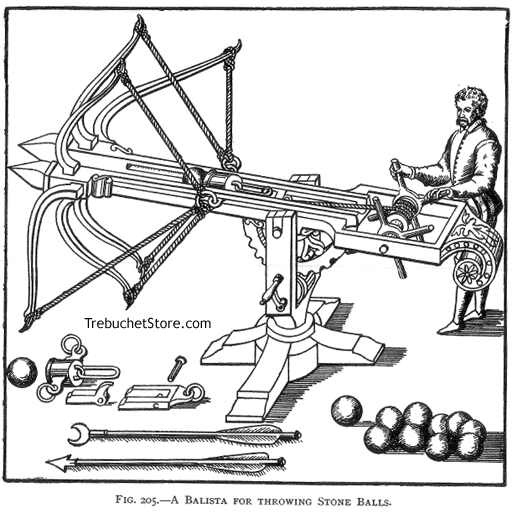
For defense, the Widow is armed with a ram on the bow, as well as two ballistas, one of which is a little scarier than the other. You see, I’ve been drawing the “big crossbow” ballista in my maps for a while now, but I wanted to change things up a bit, so I started searching for different ballista designs. I found a few I liked, but then– out of nowhere– this thing struts into the room. Yes please.

I don’t know if it’s real and I don’t care. It’s awesome and I decided it was definitely going in the map. I made a token of it, too, by the way, as well as the other one. You can get them both here. Personally, I’d give it around double the range and damage of a regular ballista in the DM’s Guide, but require a 2-person crew to fire it every round. And give it +1 to damage if the party names it.

So, here’s a funny story from my game. A few years ago, my players spent some time on a ship like this one, down in the underdark. The orog crew ended up teaching them Orcish, which my wife’s elven wizard got quite good at.

Several months later, she’s with a different party, being confronted by orc bandits, and she uses her knowledge of Orcish to speak with them.  The bandits look at each other and burst out laughing, which leaves the party confused. Finally, the orc leader stops laughing and tells her he’s never heard an elf in a fancy dress speaking Orcish. And he never imagined that, if he did, she’d be speaking the filthiest Orcish he’s ever heard.

They end up eating with the orcs, who tell her that everything she says is heavily laced with curse words. She hadn’t realized it, but the orog sailors taught her to speak like they do, which is very crudely, even by Orcish standards. So she knows the language, but she can’t speak it without cursing. Fortunately, orcs don’t tend to be prudish about that kind of thing, but no one expects it from someone like her.

Anyway, next up, I’ll be drawing a mountainous island settlement. And after that, I’ll be coming back to draw something else from the Black Loch. Maybe the illithid ruins? We’ll see.

Well, I’m gonna grab some coffee and start sketching some islands. Let me know what you think of the Widow!

There’s an annotated version of this map and DM notes available to patrons.

The result of a hard day’s work in the token mines.

You can download these tokens here.

With the exception of one random elf, all 17 of these tokens fall into one of two categories:

  1. The forces of evil
  2. Camels

Let’s talk about one of the camels. A year or so ago, I mentioned something I’d discovered called a “zamburak.” This is a camel with a swivel-mounted cannon on its back and it is an actual, 100% real thing. And now you have a token for it in case you’d like to light your players up with some camel-based artillery! However it goes down, I’d say it’ll be their first time having that particular experience.

But the best part won’t be the battle. It’ll be when Dave Smartguy tells you how completely unrealistic a cannon mounted on a camel is. Google it, Dave. Go on, do it. We’ll wait.

As I said, I’ll be drawing another Black Loch map next. This one isn’t marked on the map, but it’s just as important: a ship. Chances are, if you decide to run a game in the loch, your players will need one and all the maps of galleons, cogs, caravels and other sailing ships are going to look a little out of place in a sea without wind. So I’ll be drawing a modest-sized galley with no masts that’s better suited to the environment. I expect it won’t take long.

Anyway, I hope you like the tokens! If you’re new here, I’ve got about 300 more tokens for you here. And 11 more here. Oh, and here’s another 43. Feel free to share these with anyone who might need them.

The Smoldering Abyss

Here’s an alternate version if you’d prefer the place dried out.

The Smoldering Abyss is a part of the Black Loch almost no one even knows exists. It’s a deep, underwater trench at the bottom of a larger underwater trench at the bottom of the loch. And, in a place where no one even wants to think about what might be under the surface of the sea, places like this tend to go unnoticed.

There are three things of note here. The first is an ancient, kuo-toan royal catacomb. Built thousands of years ago, before the kuo-toa became… let’s say “psychologically non-conformist,” it was a place where they buried their kings.

The second thing is a monster called “the Whisperer.” It’s a huge, black beast with rubbery tentacles and a wide, fanged mouth like an anglerfish. While not as big as a kraken, it’s more than big enough to scare the hell out of the sailors of the Black Loch. Fortunately for the sailors, the Whisperer hasn’t been seen in almost 250 years and many believe it to be dead. Unfortunately, they’re wrong and it’s not. It’s hibernating here and it’s about to wake up.

Finally, there are the smoking rocks. Those are a type of hydrothermal vent known as a black smoker. They’re like tiny, underwater volcanoes that pump boiling hot water filled with minerals into the sea and are usually found around 3km below the surface. If you’re planning to use the map, keep in mind that those vents would actually make the water fairly warm here. And they’d burn anyone who got too close pretty badly.

With another Black Loch map down, I’m going to spend the rest of the day drawing some tokens, which I should have for you sometime tomorrow. After that, I want to check another Black Loch map off the list. I’m not sure which one, but I’ll let you know in the next post. Then, I’ll be drawing last month’s Cartographic Congress winner, a mountainous island settlement.

Anyway, that’s the plan for now. Let me know what you think of the abyss!

There are DM notes for this map available to patrons.

Altar of the Black Lamb

This map was the demonologist’s tower chosen by the Cartographic Congress. One of the stipulations was that it would have a portal to hell and I decided to go a little… non-traditional with that. “Traditional,” in this case, would be your standard-issue Door of Fire. And the problem I have with that is that it’s boring. It’s been done and it’s not scary. It doesn’t give players the sense of fear they should feel when they’re about to travel to a place where literally everybody wants to torture you to death.

So I came up with something else: a black void in the chest cavity of a rotting, dismembered storm giant. It’s the most awful thing I could think of and, to me, it’s the kind of welcome mat Hell needs. And, since “Create a Permanent Gate to Hell” isn’t a spell in the Player’s Handbook, who’s to say it doesn’t require a dead giant as a component?

I think it works pretty well in the other direction, too. If the plan is for something to come out of the portal to attack the party, it’s going to be a lot scarier after pulling itself up out of that thing. Imagine a pit fiend coming out of there. Imagine narrating that. Holy crap.

Next up, I’ll be drawing a map from the Black Loch. I want to get some serious work done on the Loch over the next few months and I’m going to start with the Abyssal Caverns, a series of caves and tunnels in the sides of a deep, underwater crevasse. I don’t have too much of a plan yet, but there will probably be a kraken’s lair.

Also, I wanted to say one last thing to the old school DMs out there. If you played D&D in the 80s or 90s, imagine using this map and your parents walked in and saw it. They’d be like, “I knew it! I knew you were worshipping satan!” Haha, oh man. I’m glad that’s not a thing anymore.

There’s an annotated version of this map and DM notes available to patrons.

Fort Bourtange – Roof Level and Dutch Version

Here’s the roof level, which is the last part of Fort Bourtange. I also made something else: an annotated version in Dutch, which I’m giving out to everyone.

I’m aware that everyone in the Netherlands under the age of 105 speaks perfect English along with 50 other languages, so I know you probably don’t need this, but I still thought it’d be nice to do. Plus, the English version comes from a Dutch tour map I translated, so I figured I could just not translate it and make a Dutch version that way. There are a couple things I had to use Google for, so I can’t promise it’s perfect, but let me know if anything is wrong or just super weird and I’ll fix it.

Anyway, the next map will be a demonologist’s lair, Remember A Dark Place? I’m gonna try to make someplace freakier than that. It’s not Hell, but it’s the home of… well, a big fan of Hell. A Hell stan, if you will. Hopefully I can come up with something uniquely terrible.

I’ve also got the next historical map picked out, which I’ll be doing sometime in the next few 2-3 months. This time, I’ll be drawing a place in Britain– or, more specifically, Scotland. There are some incredible places in Scotland, like Stirling Castle, the Wallace Monument, and about half the buildings in Edinburgh. Instead of drawing any of that stuff, I’m going to draw Coxton Tower. It’s a towerhouse in Moray and I think it’d make a great map. It’s not huge, complicated or flashy, but it’s interesting. It’s got some unique character, both inside and outside, and it’s the kind of place everyone can find a use for.

I don’t know exactly when I’ll start on it, but I definitely want to put some work in on the Black Loch first. That’s Scottish, too. Well, a little. I mean, it’s not the Black Lake. Anyway, I’m gonna go sketch out some freaky demon stuff. If you’ve got any thoughts on any of this, let me know!

Fort Bourtange

In the 1500s, the Netherlands were ruled by the Habsburgs. The Habsburgs were an astoundingly inbred German noble family with faces that were about 85% chin. For some reason, they were the rulers of the Spanish Empire.

The people of the the Low Countries didn’t want to be ruled by German people, Spanish people or inbred people, let alone a combination of the three. They wanted self-determination, a republic and the right to worship the protestant version of God. So, in the mid-1500s, the Dutch Revolt began.

The Spanish Empire ruled Spain, part of Italy, Austria, and– you know the countries that speak Spanish today? All of those. It was a daunting enemy, but the Low Countries had one thing going for them: stupefying amounts of money. And they planned to leverage that to win.

One of the things the Dutch spent that money on was Fort Bourtange. Since the Spanish were allied with the Holy Roman Empire, they’d need a way to protect the Dutch land from the Deutschland. One of the main roads to Germany passed through a marsh, so the leader of the revolt, Willem van Oranje, ordered the construction of a fort across it.

Building a star fort with forty buildings, a crownwork, four ravelins and two moats is an expensive operation. But not only did they build it, they built it on a sandbar in the middle of a marsh.

Fort Bourtange was such an obvious deathtrap that not many people were inclined to order their armies to assault it. But, about 100 years after its construction, Bernhard von Galen, the Prince-Bishop of Münster, came along to give it the old college try. During a parley before the attack, he told the fort’s commander, Captain Protts, he had 200,000 guilders for him if he’d surrender Bourtange. Protts famously responded by telling von Galen he had 200,000 bullets for him and his men. Von Galen decided to send his soldiers to go receive them, which resulted in a crushing defeat for his army. He then went on to besiege the nearby city of Groningen, which he also failed at.

In later years, the fort began to transition into a village, where the soldiers of the garrison lived with their families. Then, in the 1800s, the fort was turned into a village for local farmers.

Well, this map was a ton of work, but I hope you like it! I’m going to make a roof-level version of the fort next, which should only take a couple days, then I’ll be moving on to the next map. I plan to make a big push on getting some Black Loch maps done over the next few months as well.

Anyway, let me know what you think of Fort Bourtange!

There’s an annotated version of this map and DM notes available to patrons.