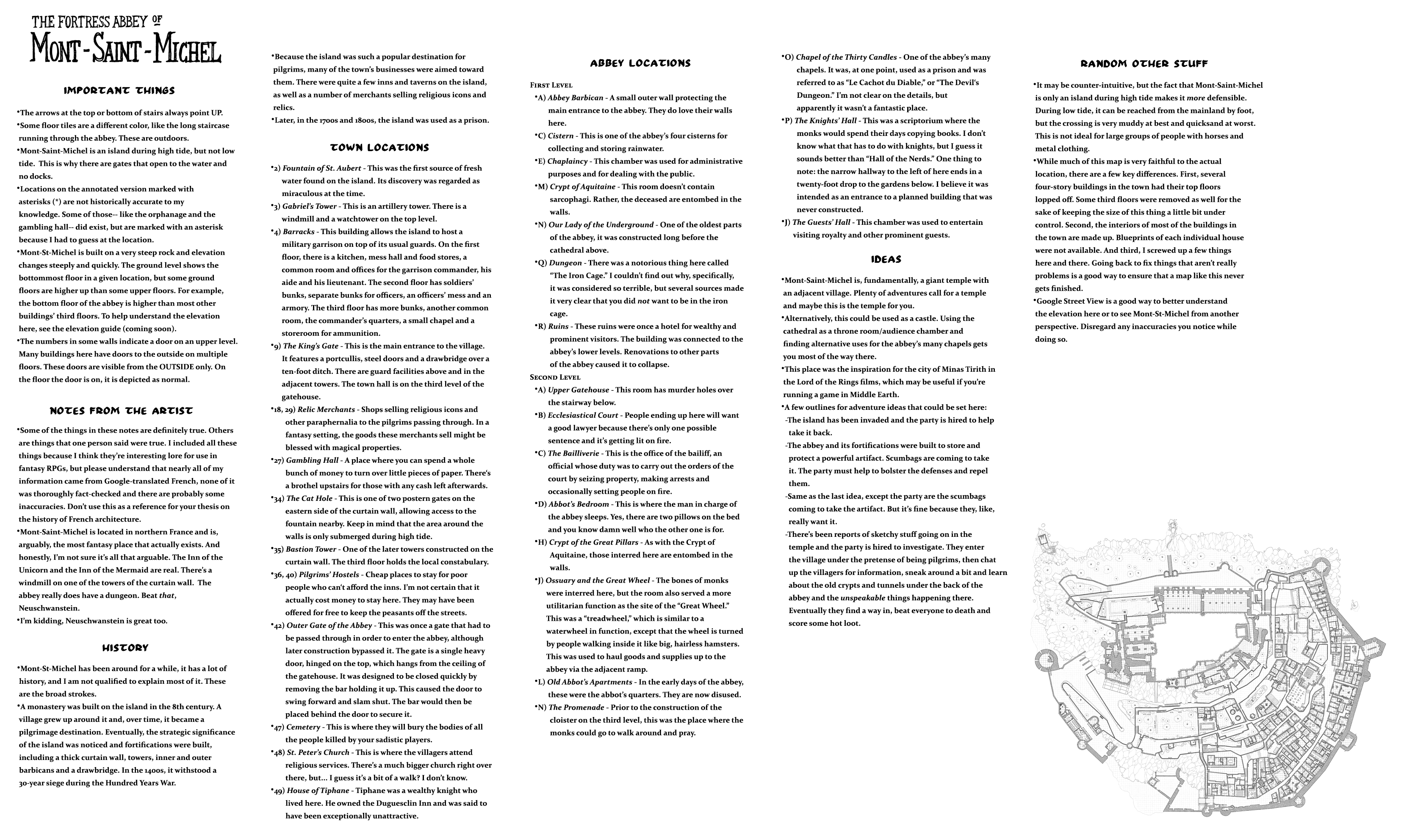
Mont-Saint-Michel – Fourth Level

Here’s the annotated version, the elevation guide and the DM notes. If you need the free VTT stuff, it’s on the patreon.

It’s been quite a journey, but here we are at the end. Time to chuck the ring into the volcano and start on the next adventure.

To all my patrons, thank you so much for giving me the opportunity to make this. I try to draw maps that no one else makes and create unique settings for your games. Hopefully Mont-Saint-Michel will serve you well.

The elevation guide is up there. The French version isn’t, but my French language consultant is coming over for D&D in an hour and I should have it up tomorrow morning. Tonight, I’m gonna DM my game and celebrate the end of this project with fermented beverages.

Starting tomorrow, I’m getting to work on the backlog of Cartographic Congress maps. First up is Predjama Castle, a Slovenian castle built in the mouth of a cave.

There are hi-res print versions and a whole lot of VTT versions of this map available to patrons.

Mont-Saint-Michel – Third Level


Here’s the annotated version and the finished DM notes. The free VTT stuff is on the patreon.

This is almost everything. The DM notes are done too, although I reserve the right to change my mind about that tomorrow. There are a couple things left to do:

  • Color the roofs. Easy, easy stuff.
  • Make furniture tokens. I promised someone I’d make them so they can mod the Mont. Even easier.
  • Stacked floor maps for VTT. Here’s one that’s finished so I don’t have to try to describe them. A patron told me this is how he used Finbarr’s Marsh: he’d use the roof map when players were outside, then, when they entered a building, he’d change to a map like the one there, with all the levels in one. I liked the idea and I’m making them for this. Let me know what you think.
  • The elevation guide. I’m making that from the roof level, so it should be up at the same time.
  • I’m still planning to make an annotated version en Francais, but I need my French friend to check it first, so it might be a minute.
  • Anything else I’m forgetting, which is hopefully nothing. Slap me if I’m wrong about that.

Mont-Saint-Michel – Second Level


First: here’s the updated DM notes and the non-annotated version of the map. And the basic VTT files you’ll need to use this on Roll20 or FG are attached to the bottom of this post.

I’ve talked about the map a lot. I feel like talking about my D&D game today.

So I recently started running a game for my friends again after about a year and it feels good to be behind the screen again. Our group is… a little atypical.

First, it was almost the case that every person in the group was from a different country. I, the DM, am American. The wizard (and my wife) is Irish. The druid is Spanish. The monk is French. And the paladin is Norwegian. But, at the last minute, we went double-Spanish, which ended up being a good thing, since he played a rogue, which is a good thing for any party to have. And since, during the first session, he was the only person who seemed to be able to roll double-digit numbers on a D20, allowing the party to slowly but eventually kill the small number of poorly-armed goblins I’d put before them.

We also later got another Irish player who became the party’s ranger. Which brings me to the second unusual thing: the names. Oh my god.

So, the ranger is, ahem, “Polycarp Manius.” Um. Okay.

The monk is “Morzaninov,” which has something to do with how “more than enough” is pronounced with a French accent.

The wizard has a mile-long super-elvish name that I can’t remember.

The paladin is “Adobos,” which is passably normal.

The druid is “Blyantspisser,” which is the Norwegian word for “pencil sharpener.” Seriously.

And the rogue is “Garrett,” which, in this party, seems so oddly normal it’s almost mundane, like a character named “Bob” or “Gary” would be in most parties.

So that’s the group. They’re making their way through Lost Mine of Phandelver at the moment and they’re getting better at rolling dice. I’ll let you know how it goes.

Mont-Saint-Michel – Ground Level


Here’s the annotated version and the DM notes.

This is what the last few months have been leading up to. Hopefully it’s everything you were expecting. There’s still the upper floors to color and a few other little things to do, but we’re almost there.

A few things. First, DM notes for everybody. There are some things we need to talk about with this one and that’s where we’re talking about them. It’s all under “Important Things.” Feel free to stop reading after that if you want.

Second, non-patrons will notice a ZIP file attached to this post on the patreon. If you play on a VTT, you’ll need those. They’re individual sections of the map so you don’t have to try to get Roll20 or Fantasy Grounds to try to choke down the whole island at once. There are more VTT options for patrons, but I want everyone to be able to use this and those files are necessary for that. I care about those of you who aren’t giving me money too, you know.

Third, the DM notes are only half-finished. I wanted to get this posted and I’m not letting a little thing like incomplete DM notes stop me.

Finally, there’s going to be an elevation guide and some other VTT options to come, but those will require multiple floors to be finished, so they’ll come at the end.

Anyway, what do you all think? If you’ve got any questions, just ask. I may not know the answer, but I’ve been living and breathing this place for the last few months, so it’s worth a shot to ask.

Brazenthrone: History and Lore, 3rd Edition


As promised, here’s the 3rd edition of the lore. I added a summary of each of the different districts of the city and some of the more notable buildings, like the Freehammer Forge and the Amethyst Arcade. It’s stuff that I felt like I should explain for people who don’t have access to the DM notes. While I tremendously appreciate the 187 people who are funding the creation of Brazenthrone, I also want it to be usable by people who can’t afford to be patrons and people who won’t discover it until 10 years from now.

If you are a patron and you’ve read through the DM notes, there’s still a few new things here. There’s some advice on using the city under “Notes from the Artist,” there’s an explanation of how the city is lit under “General Information” and the last entries under “Foreign Relations” and “Society” are new as well.

And with that done, I’m going to begin the task of stitching every chamber of every floor of Brazenthrone into a single image. I’d guess that’ll take one day, maybe two, depending on how many times I crash Photoshop in the process. I’ll take a photo of the originals, too, to show you how many trees had to die for all this.

Anchorage Isle

In honor of my wife’s birthday and the 1-year anniversary of the site, I’ve decided to give away everything for this map. All the patron content is free for everyone:

  • DM notes
  • VTT versions (includes Roll20 and FantasyGrounds sizes)
  • Print versions (in PDF)
  • You can download the 1-inch grid print version and a complete zip with everything in it from the patreon (they’re big files and patreon’s servers are much faster than mine).

Be sure to check out the DM notes if nothing else. There’s lore about the distillery, which makes the world’s most godawful hooch, the mysterious guy who lives in the manor house, and the island’s only tree. There’s also an idea for an adventure that’s inspired by a Clint Eastwood movie. Anyway, I hope it helps!

In the past, I normally haven’t done two really big maps in a row, but I’m starting to realize that’s coward talk. Next up is the most dwarven area of the dwarven city of Brazenthrone: the Anvil Quarter. Prepare your beard.

EDIT: I think this is my 72nd map. 72 in a year seems like a decent start.

Delvers’ Rest – Brazenthrone’s Waystation on the Underdark Stairway

I’m giving out the DM notes for this map to everyone because I think they’re pretty good and I want to share them. I didn’t think I’d have too much to say about Delvers’ Rest at first, but then it occurred to me that this would probably be the foulest-smelling place in the city. I won’t explain the reason here, it’s in the notes if you’re curious.

The next map is something I thought was an interesting idea. Do you remember the Buried Tower? That’s not a map anyone was looking for before I drew it, but people seemed to like it and found ways to use it. The next map is a bit like that. It’s different, but I think you’ll like it. After that is the Pits of Justice– Brazenthrone’s prison– which is adjacent to Delvers’ Rest.

Anyway, here’s the version of Delvers’ Rest without the annotations. There’s an expanded annotated version with the rooms of the numbered buildings marked available to patrons.

Tortuga – Overview and DM Notes

Here’s the final map of Tortuga: the overview.  The image above is the gridless version because I think it looks better.  I’m not sure why.  Here’s the gridded map.

Also, I’m giving away the DM notes on this one because they explain some important things about this map, as well as my thoughts on the ways it can be used in a campaign (especially as a traveling home city for PCs).  Here they are:

So, now that the six-story turtle town is out of the way, it’s time to start on something much, much bigger: Brazenthrone.  I’ll have a map of the layout of the city up on Monday.

Drow Surface Raiding Outpost


This is my idea of what a drow outpost for raiding the surface might look like.  Built into a cliffside, it has only one entrance to the surface, which is a narrow tunnel in the roof of a small cave, accessible only by a rope ladder, which would normally only be deployed when drow are coming or going.

The cottage above the cliff would have been built by the drow as well.  Although they have no use for the building itself, they would need a way to vent the smoke from their cooking fire without drawing attention to the presence of their outpost.  By running the house’s chimney directly to their vent shaft, they can make it look like the house is producing the smoke.  Of course, this will not pass close inspection because the house itself has no fireplace or occupants.  That might be useful as a way to allow the PCs in your game to discover the outpost.

Anyway, I hope you like it!  I’m giving out the annotated version for free on this one:

The Elven Citadel of Oakenhold


This one took some time.  Whew.  The annotated version is below.  Since the image is big enough as it is, I decided to write the DM notes here:

  • Let’s get this one out of the way first:  You’re not burning it down.  Well, not without a lot of effort, anyway.  The tree is 40 feet in diameter at the base of the trunk (that’s 125 feet in circumference).  That’s a hard log to burn.  And getting there to start the fire means getting shot at by a whole lot of archers.  Levels 2, 3, 6 and 7 are all lined with arrow slits.  And from 100-200 feet up, they have the range advantage for sure.  You have a mage who knows fireball?  Check the range.  He’s a pincushion long before he gets that close.  Brought a catapult?  Ballistas?  Level 5 has three ballistas with bows almost 20 feet across.  They are there specifically to disable war machines.  Is burning Oakenhold impossible?  No.  But the elves who built it did take that into consideration when designing its defenses.
  • Oakenhold is not designed to be a seat of power, from which a king rules.  Rather, it is meant to serve as a military stronghold for defending the land around it.  This is why there is relatively little in the way of luxury or space devoted to the nobility.
  • If you want to make it a seat of power, I would recommend changing the archery range at 24 (see annotated version below) into a throne room/audience chamber and devoting most or all of the 8th level to the nobles.  Change out the rooms for a bath, a dining room, a sitting room, a study or two, maybe a vault.  You get the idea.
  • So, what do you do with a ten-level elven tree fortress?  I’ve got a few suggestions:
    • Attack it
    • Defend it
    • Infiltrate it
    • Steal something from it
    • Sabotage it
    • Kill someone in it
    • Escape from it
    • Help the elves take it back from the people who took it from them (possibly involving one of the above).

Also, I started a Patreon today, if you’re interested in giving me some support so I can spend more time making stuff like this.  If not, its no problem at all.  Just wanted to mention it.

Finally, here’s the annotated version:


Edit: And here’s a version that’s easier to print: Page 1, Page 2