Ptarmigan Bluff: A Mining Village on a Cliffside

First of all, this is what a ptarmigan is. They live in the mountains. The “P” is silent, but is included in the spelling because the English language is designed to inhibit the spread of literacy at all costs.

I really like the idea of a village built against a cliff, but drawing one turned out to be a lot harder than I expected. Still, I do like a challenge and I think I’m happy with it. The hard part was putting this all together in a way that makes sense.

You see, drawing a five-story building is one thing. But drawing 10 different buildings with five floors among them, all tied together with stairs, walkways and bridges… well, that’s a little more complicated. I numbered the buildings on the sideview to indicate which buildings are on which levels and I hope that’ll make it easier to understand. But if you’ve got any questions, by all means ask.

Next, I’ll be drawing another map for Tir Thelandira. Specifically, I’m going to draw the ruins of the burned mining colony. You can see a list of what’s left to draw in this post.

Speaking of Tir Thelandira, the poll for the first of three undecided locations is still open for patrons who want to cast a vote. Since there were 21 ideas submitted for the first location, I’m dividing them up into three votes of 7, then holding a runoff for the winners to determine what the location will be. I’ll start the vote for the second group of 7 in a day or two.

Well, that’s it for now. If you’ve got any thoughts, let me know!

The Stonestead

The Stonestead is a broch. They’re a real thing and there are a bunch of them in Scotland. I drew this particular broch for the island of Tir Thelandira, whose wood elf inhabitants have a distinctly Celtic-flavored culture.

The Stonestead is the elves’ first foray into large-scale stone construction. Built to defend a gap between the northern and southern parts of their forest, it’s meant to ensure that, should the Dhasran colonists or their mercenaries decide to march on the elven lands, they have to either fight their way through the fort or venture into the woods, where they’ll be easy prey for elven archers and ambushers. Neither option is great– but, of course, that’s the idea.

I’ve received quite a few proposals for new locations for Tir Thelandira. If you’re a patron who’s got an idea you’d like me to add to the ballot, you’ve still got time to shoot me a message. Just to recap, the proposals are for either the location marked “1” on this map OR the swamp to the east of Oakenhold. I’ll be posting the first vote in a few days.

Next up is an East Asian-style village built into a cliffside. This picture should give you an idea of the sort of thing I’ll be drawing. Personally, I think that’s nuts. I mean, how is that a real place? What happened there? I don’t know, but I’m glad it did. Because that’s awesome.

Palazzo di Nettuno – Not-Quite-As-Serene Version

So, Palazzo di Nettuno means “Palace of Neptune” (or at least Google Translate says it does), although that name is a bit more fitting for the other version of the map. Whatever, it’s fine. This one can be a reference to the planet.

Next, I’ll be drawing another map from the island of Tir Thelandira. This will be a sacred cave of the elven druids. I picture it like this: a cavern with an opening in the roof, through which light pours in.  In the center lies a mossy pool surrounded by intricate knotwork engravings. This pool is used as an oracle by the druids, who gather here to seek advice from their goddess.

There may be a bit more to it, but that’s what I’ve got for now. If anyone has any ideas that might make it a bit more interesting, by all means let me know!

Palazzo di Nettuno

I think Venice is the kind of place a fantasy writer would come up with. “It’s this city in a harbor, you know? Trade port, super rich. Really beautiful. And get this: the streets? They’re made of water.” It’d be a really cool concept if it weren’t for the fact that it actually exists.

Of course, not everyone has a fantasy version of Venice in their game world, but I think this could be used as a palace with a moat as well. And I’m going to make a dry land version, which I should have up by tomorrow. Someone suggested turning the boathouse into a stables, which sounds good to me. I’ll draw in a few bushes, a happy little tree, it’ll be great.

By the way, I’m not sure if this map is supposed to be in daytime or a brightly moonlit night. I just started coloring without really thinking about it and this is what happened. Anyway, if you figure it out, let me know.

Okay, I’m gonna go draw some grass on this thing. Be back with that soon!

The George and Dragon Inn – A 17th-Century Coaching Inn in Southwark, London

This map is based on a historic inn in Southwark, London. The establishment’s original name was The George and Dragon, although it’s known today as The George Inn. Personally, if it was up to me to abbreviate the name, I’d have kept the Dragon part and sent George packing, but I suppose that’s not the way the owners decided to go with it. They did keep the dragon on the sign, at least.

The George and Dragon was originally a coaching inn, which is an inn designed to accommodate stagecoach travelers, with large stables and space for carriages. Not many coaching inns survived the transition from stagecoaches to train travel, but The George was fortunate enough to be close to London’s railroad, which enabled it to stay in business. Lucky guy, that George.

I’ve gotten quite a few comments and messages with ideas about Tir Thelandira and the second civilization that will be living on the island. Tomorrow, I’ll start working your ideas into 3 or 4 different proposals, which I’ll put up for patrons to vote on.

Each of the proposals will be inspired by things you suggested and will probably contain suggestions put forth by several people. I won’t be able to work everything in, but I do appreciate all of your contributions. Some ideas, like an aquatic civilization, won’t make it onto the ballot, but I do absolutely want to include those in this world eventually.

Anyway, I’ll get those ideas fleshed out and post a vote in the next day or two. After that, I’ll be drawing the Barre Sinister, which is a Spelljammer-themed map that isn’t actually a spelljammer. It’s a tavern floating on a giant, stone hand that floats through space. So that should be a little something different. For those of you whose parties aren’t capable of generating enough Delta-V to reach a place like that, I’ll be making a sea version of the map as well.

All right, hope that sounds good. Let me know what you think of the map!

Frog’s Haven Crannog

In the last post, I talked about my plans for the first island of the as-yet-unnamed big project. There will be two civilizations living on the island, one of which will be a kingdom of wild elves.

Over the past century, the wild elves have been shifting from a tribal, nomadic society to a settled one. While the elves have become better at building large structures of timber and stone, their skills at architecture are still well behind those of other civilizations. To reflect this, many of the wild elves’ settlements will be inspired by Iron Age Celtic buildings from Ireland and Scotland. Here’s a breakdown of what I have in mind:

Crannog – A crannog is a man-made island with one or more houses on it. The island was often surrounded by a wooden palisade and had either a narrow causeway or a path of stepping stones leading to the shore. Crannogs were most common in Ireland and Scotland. Frog’s Haven will probably be the only one.

Broch – A broch is an old style of Scottish towerhouse, which looks like this. I think I’d draw this fairly similar to the one pictured, perhaps with some farmland around the walls. I’d also give it a slightly more elven, tribal look.

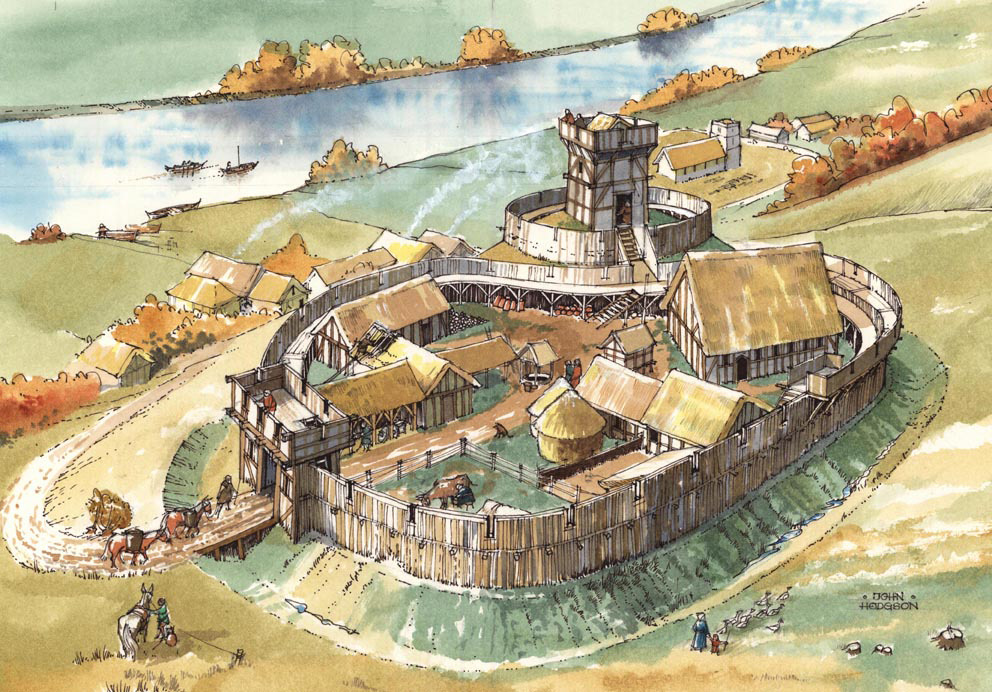
Motte and Bailey (or something similar) – A motte and bailey is an old style of wooden castle, which looks like this. I’d probably use a more elaborate version of the design and I’d make it more of a walled village rather than a fort. Again, it’d have an elven style to it as well.

OakenholdThis is one of the first maps I ever posted. I’ve never redrawn a map, but I want to redraw this one and I want it to be the seat of power for this wild elven civilization. I’ll change plenty about it, but it’ll be the same basic design. This is where the king or queen lives.

That’s the plan so far. There will probably be other locations as well, but I want to get your opinions on these ideas first. If the response is largely negative, I’ll come up with something else. If it’s positive, I’ll get started on a map of the island and we can start figuring out where things are and who the elves are sharing the island with.

Anyway, let me know what you think of the Celtic wild elves. Positive or negative, I really want to hear your opinions!

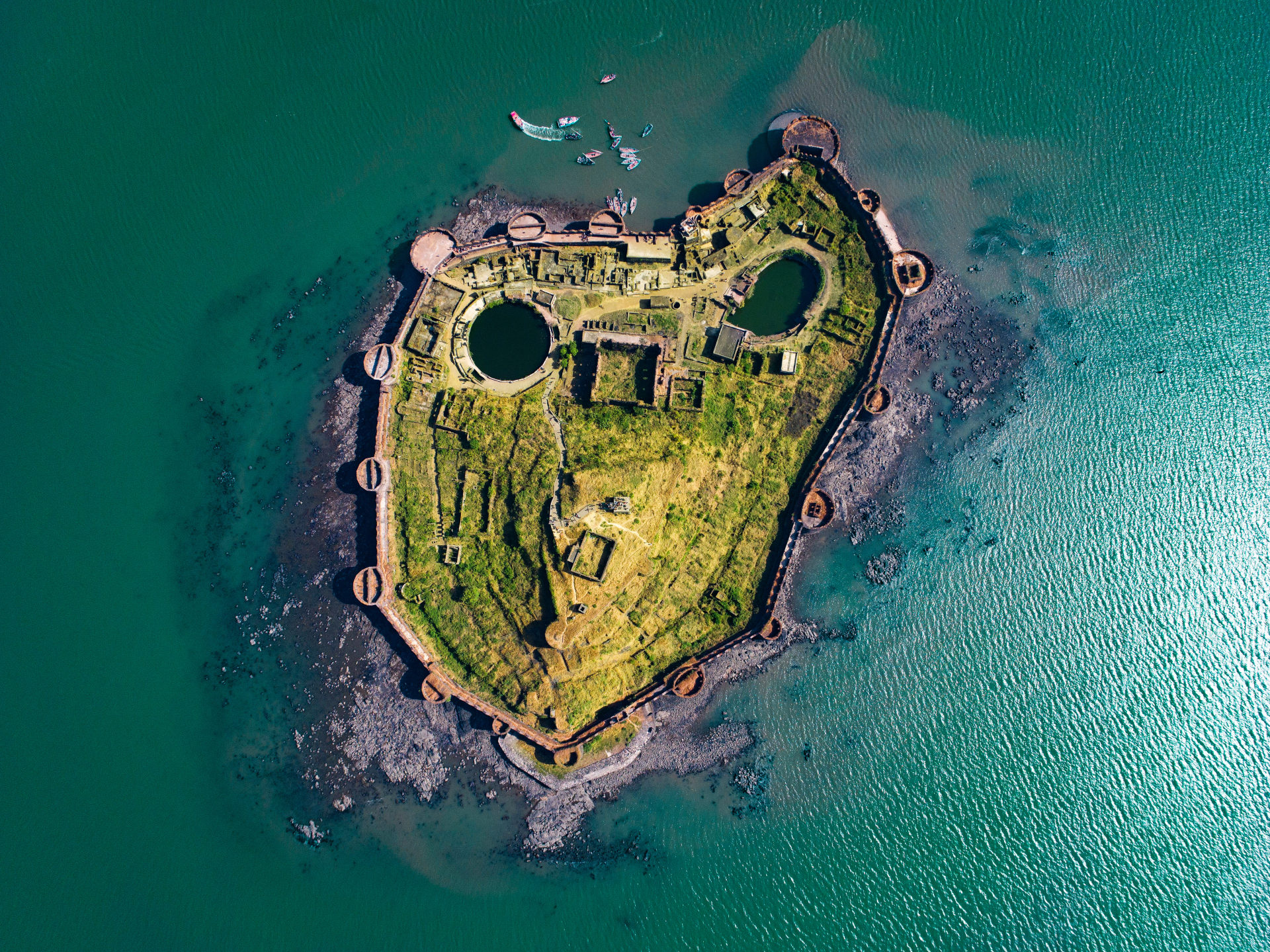
Murud-Janjira: An Island Fortress in Maharashtra, India

I made an annotated version of this map, which was only possible with the help of Aditya, who translated the only labeled map of this fort I was able to find, which was in Hindi. I’m very grateful for the help and the least I can do is pay it forward and give the annotated version away to everyone.

Murud-Janjira was built in the 1400s and was only taken by force once. The Maratha Empire assaulted it about a dozen times. They climbed the walls, they tried to dig their way in, they even built a fort nearby called Padmadurg to use as a staging ground for an attack. None of this succeeded. The Virgin Padmadurg was no match for the Chad Murud-Janjira.

So how was it taken? With booze. Let me explain. The fort was built by Ram Patil, the Admiral of the Ahmadnagar Sultanate. Once it was finished, Patil and the Sultan had a little falling out, Patil stopped taking the Sultan’s orders and they unfriended each other on facebook. The Sultan appointed a new admiral named Piram Khan and ordered him to take back the fort.

So Khan dresses up as a merchant and sails to the fort. He says he’d like to leave some crates of silks and wine inside for safekeeping. You know, temporarily. “Sure,” says Ram Patil, “You can leave your booze and loot with us. We’ll be happy to hang onto it for you. You know, temporarily.”

So they start bringing in the crates and Khan decides to throw a little party for Patil and his men for doing him this favor. At this point, you have to imagine that Ram Patil thinks he’s talking to the dumbest man alive. Still, Khan cracks open a few casks of wine and everyone spends the evening getting drunk. Later that night, once Patil and his men are completely hammered, Khan goes back to those crates they brought in earlier and starts opening them up to let out the soldiers hiding inside.

You can probably guess where it goes from here. They attack the drunken garrison and take back the fort. The moral of the story is that sometimes thinking outside the box means literally getting into a box.

Anyway, I’m gonna go to bed. I hope you like the map!

Akshardham Temple: The Interior

Several months ago, a patron said that India was underrepresented in fantasy settings and I agreed. Take the Forgotten Realms, for example. Faerun is inspired by Europe, of course. Then you’ve got Zakhara, the Arabian part of the world. And then there’s Kara-Tur, which is East Asia, and Maztica, which is Mesoamerica. Technically, there’s an Africa, but almost nothing is written about it, so that doesn’t really count. But there’s no India.

Well, I can’t make a whole Indian setting, but I can draw a map of something Indian and I decided to go with Akshardham Temple. I’m going to draw another map of a historical place in India next, but for a different reason. The island fortress of Murud-Janjira won last month’s Cartographic Congress, so we’re going to have a subcontinental doubleheader.

For a few reasons, I’m going to draw the place in ruins as it is today. The first is that I think it’s more interesting that way. And it doesn’t prevent it from being used as a fort, since, in FRPGs, ruins tend to be occupied by pirates, goblins, ogres, cultists, etc.

The second reason is that, after an hour of searching, the only labeled floor plan I’ve found of this place is in Hindi. Or possibly a different Indian language. In any case, my keyboard doesn’t have those buttons on it, so I can’t use Google Translate to find out what everything is. But if it’s in ruins, that’s not really a problem *taps forehead*.

Anyway, I’m gonna grab some coffee and get started on that. Let me know what you think of the map!

Akshardham Temple: The Exterior

Akshardham is a Hindu temple in New Delhi, India. This monument to the gods was constructed long, long ago, back in the year… *checks notes* 2005. Few remember what life was like in those ancient times, but historians say the telephones of that era could be folded in half. I didn’t actually realize this place was so new until I’d already started drawing it, but I’m really happy that people are still building places that would make good fantasy maps.

Akshardham is dedicated to several deities, but the primary one is Swaminarayan. I’m not actually clear on whether Swaminarayan is a god or not, but he is believed to be the manifestation of Krishna, who is definitely a god. So, does that make him a god by extension? I don’t know enough about Hinduism to answer that question, but in any case, they did build a pretty spectacular temple in his honor.

Next, I’ll be drawing the interior of the temple, which should only take a few days. After that, I’ll be drawing the map chosen by last month’s Cartographic Congress, which is also a real place in India: Murud-Janjira, an island fort just off the western coast. Having just drawn the map above, I am very pleased to say that Murud-Janjira has no roof whatsoever. THANK GOD. You make a lovely roof, guys. You really do. But they’re not easy to draw.

Anyway, I’ll have DM notes and all that once I’m done with the interior, but until then, I hope you like the map!

Great Bombard: Spelljammer goes brrrrrrrrrrrrrrrt

The Great Bombard isn’t a ship, it’s a gun. A really big gun. This gun does has a ship attached to it, though. This accessory, mounted under the barrel, allows a crew to move the gun through space and blow things up in a variety of interesting and exotic locations.

If you allow your party to acquire a Great Bombard, I don’t think that’s unreasonable. But you do need to keep it in mind when planning adventures from that point on. Ask yourself, “Can my players solve this problem using nothing but their big gun?” If so, you may want to make a few adjustments so the party has to put a little more work in. That said, you’ve got to let them blow something up every once in a while. That’s half the fun of having a ship like this, after all.

Since the new Spelljammer was recently released, I’ll probably draw another spelljammer map sometime in the next two months. I’ll hold a vote to let patrons decide which one you’d like to see.

But first, I’ll be drawing India’s Akshardham Temple. Then, I’ll be drawing the map chosen by last month’s Cartographic Congress: the Indian island fortress of Murud-Janjira. I’ll be drawing it about how it is in this photo: overgrown and in ruins. Personally, I think that’s much more interesting (and it also gets around the problem that the only labeled floor plans I’ve been able to find are in Hindi).

Well, I hope you like the Great Bombard. I’m gonna get started on this Indian double-feature. Let me know what you think!